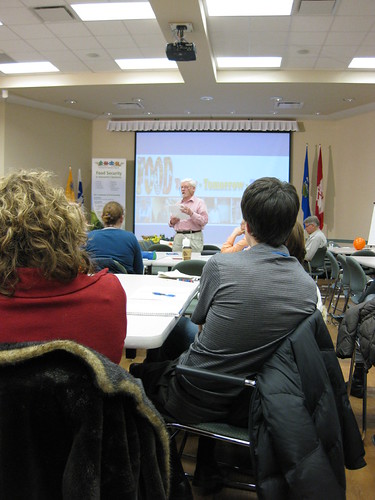
Day 2, pm – Food: Today, Tomorrow, Together Conference

After lunch, I was finally able to move from the auditorium into the more small-group friendly rooms for the day’s second breakout session. Titled “The Capacity of the Alberta Food System”, I was disappointed that the content didn’t actually provide more information about the capacity of the Alberta food system.

Candace Vanin, an agrologist with the Prairie Farm Rehabilitation, Administration, Agriculture and Agri-food Canada provided some interesting facts:

  • 8% of land in Canada is suitable for food production, with over 80% of that farmland positioned on the prairies;
  • Edmonton has a fairly good agro-climactic zone (rated 2H on a scale of 1-7, with 1 being excellent for agricultural activity), and has 143 frost-free days due to the geographic “bowl” the city is situated in; and
  • there are 170 census farms in Edmonton, and that 80-90% of all broccoli, cauliflower and beets in Alberta are grown in the Edmonton area.

Paul Cabaj of the Canadian Centre for Community Renewal talked about the results of a survey he conducted, but didn’t have anything particularly of interest to contribute except a mention of a social enterprise project. Apparently a group in Edmonton would like to start a greenhouse on the lands around the Alberta Hospital site to sell half of the produce to local restaurants, and use the profits to be able to provide the rest of the produce to low-income families.

Someone at the end of the session asked the obvious question – “What is the capacity of Alberta’s food system?”, and while neither presenter had an answer (partly because the answer would change yearly and be completely hypothetical), local economist Mark Anielski, who had participated in a panel discussion earlier in the day has estimated that Alberta would be able to support less than 10% of its population on its current agricultural production.

The last breakout session of the day was my favourite of the entire conference – the “Realities of Farming” offered two producers the opportunity to talk about their firsthand experience. Gene Brown, a small rancher with 170 cattle, was so honest and so well-intentioned that I wished that more people could hear him speak.

He talked about some of the changes they had implemented on their ranch over the last few years to make their farm more environmentally sound, including rotational grazing and water pumping. They also adapted some methods to reduce the stress on animals, like utilizing plastic nose paddles for seven days prior to separating the calf from its mother (meaning that they cannot receive milk from their mothers, but they have the security of being by their side for a week longer), and planting shelter trees along the side of their farm that borders the highway. Gene was very positive in his assessment of their farming business, saying that it was a lifestyle he would not give up, as it allowed him to be close to nature, and have flexible days. He closed his presentation with this: “Of all the crops we’ve produced, the ones we are most proud of are our children.” Aw.

Gwen Simpson, of Inspired Market Gardens was up next. She heavily emphasized how difficult it is for farmers to make a living in the current climate. She provided an example of her counterparts at Sunshine Organic Farm, who only make $2 per organic, pasture-raised chicken, and that doesn’t include the wages they have to pay to employees, insurance, certification, or transportation to farmers’ markets. Other notable facts:

  • Alberta lost 7.1% of their farmers (since which year, I didn’t note down). The average age of a farmer in Alberta is 52, and in the last 5 years, the province has lost 25% of farmers under the age of 35.
  • Canadians surveyed by the OECD ranked communication and health the #1 and #2 things they would be willing to pay top dollar for. Food ranked #11.
  • In 1988, 1.44kg of pork cost $6.88. In 2002, 1.46kg of pork cost $9.54, with the difference collected by the retailer and the processor, and not the farmer.

Gwen introduced the idea that perhaps farmers should be seen more as our doctors, as what we eat has a direct impact on our health. She noted that people should be willing to pay more for good food, especially if one considers proper nutrition as a means of disease prevention.


Gwen Simpson

We had another open space discussion prior to dinner, but for the life of me, I can’t remember which group I huddled around – being reliant on the notes in my Moleskine is a detriment to some extent.

I returned from dinner refreshed and ready for the final portion of the evening – a lecture from Carol Off, journalist, host of a CBC radio show, and author of Bitter Chocolate, a book that exposed the human rights violations of the cocoa industry. Immediately after her presentation, I was a bit disappointed with what I thought was a lack of content, but now, a few days later, I think it was a well-rounded case study of a commodity, peppered with people that she met throughout her visit to the Ivory Coast to investigate the situation.

“Food is the biggest story of our time,” Off opened. She gave a brief history of cocoa, and how it eventually became a prized commodity in the Western world. Her lecture then centered around the three factors that in her opinion led to the destruction of modern Africa and cocoa production: the greed and corruption of Africa’s leaders, the Structural Adjustment Programs heralded by the International Monetary Fund and the World Trade Organization, and corporate amorality by the multinationals that now “own” cocoa, and are able to drive down the price with their monopoly. On this last point, she explained, as farmers cannot afford to pay their employees because of the low rate they receive, they turn to the cheapest labour available – slave labour of children. Sadly, she even saw mothers purposely sending children into the Ivory Coast from neighbouring Mali – mothers that were hoping that being employed in cocoa plantations would guarantee them food they would not otherwise have. She herself does not eat anything but fair trade chocolate, or chocolate that contains cocoa sourced from anywhere but Africa, and reminded the audience, “When you take a bite of chocolate, just remember who’s life you’re eating.”

One of her suggested “solutions” to the problem was empowerment – of the cocoa farmers (to be able to organize, and to be aware of the true value of their product), and of us. She introduced the idea that would be rampant on day 3 of the conference that people need to stop viewing themselves as “consumers” – “The power to change lies with citizens and not consumers,” she said. Citizens can force the government to legislate the needed change – for example, introducing a bill that bans companies from importing cocoa farmed by children (in 2001, Senators Hawkin and Engel in the U.S. tried to pass what is known as the “Cocoa Protocol” to have done just this, but cocoa lobby forced their request to become voluntary only).


Carol Off

I was pretty beat by this time, but stopped in the cafeteria area to sample some included wine (from enSante, who, I am happy to announce, were granted an extension of their farmgate license and will be allowed to sell their wine at farmers’ markets this summer!) and cheese (from Sylvan Star Cheese, among others).

Day 2, am – Food: Today, Tomorrow, Together Conference

I did my best to try and blog on Friday night, but it seems my threshold for processing information was 10 hours. My cold didn’t help matters either, but now I have some catching up to do.

At any rate, the theme of day 2 was “what’s happening on local, provincial and national level”, and I think the committee did a great job of organizing sessions that addressed this topic. I started off the morning with a full thermos of coffee, the cinnamon bun I received yesterday at the Taste of Alberta, and a keynote by Elbert van Donkersgoed, Executive Director of the Greater Toronto Area Agricultural Action Committee. He talked about building blocks of a sustainable food system, with emphasis on farming just outside major cities – apparently, the value of production per acre is higher for farms closer to the city. Van Donkersgoed spent the initial few minutes deconstructing the notion of a “locavore”, and using statistics from an Ipsos Reid poll and a survey, tried to prove that though the locavore craved convenience, they are not just a passing fad. For example, 42% of Canadians reported in the poll that they had purchased locally-grown food in the last six months, 70% of the Royal Winter Fair patrons surveyed said that they change their diet seasonally, and 63% of the Fair patrons claimed they buy food based on where it comes from as opposed to the price. I was sceptical of these numbers, if not only because I think people respond to such question with the answer they think is “right” as opposed to the one that best describes their habits.

Van Donkersgoed argued that the business of farming needs to change to accommodate the rise of the locavore. He said that seasonality must be emphasized (to the point where consumers cannot get enough of the sun-kissed taste of a just-picked strawberry), consumers need to be educated on how to store fresh produce properly, and the structure of the food value chain (where supermarkets are currently the gatekeeper) must change.

He talked about Occombe Farm Store in the UK, which sells the produce of 40 local farms within 50km of the store. Situated on a conservation authority, residents can visit the farm not only to fulfill their shopping needs, but to reconnect with the land. The Edmonton Regional Tourist Group has organized opportunities for people to visit Edmonton’s countryside, but I agree with his point that urban sprawl must be reduced in favour of preserving (and ideally, increasing) the farmland around metropolitan centres.

It didn’t occur to me until he reiterated his points on Saturday afternoon, but van Donkersgoed was the only speaker that I heard over the course of the conference that wasn’t beating the drum of extreme change. Most of the speakers called for extreme shifts in thinking and practice, but for the majority of the population out there, such change just won’t happen. I’m glad van Donkersgoed expressed a more realistic (and small step) approach.

Our food-filled breaks began with a locally-sourced yogurt parfait – the yogurt was from Lacombe’s Bles-Wold Dairy, granola from Highwood River’s Highwood Crossing, and rhubarb and apple from enSante Winery. The granola, I should mention, was absolutely delicious.

Following the break, we reassembled in the auditorium for the first of three “open space” discussions. Attendees who had burning ideas were asked to lead table discussions and record the key points that had been brought up on flipchart paper. This was a good idea in theory, but with over 200 people in the room and only 6 volunteer leaders, needless to say, the groups were a little larger than they should have been.  Also, I could just see Mack shaking his head at the flipchart pages, and scolding that a wiki should be used instead. Apparently, the ideas will be collected and sent to all participants eventually, so hopefully some good will come out of them.

Wall of ideas

My first breakout session of the conference was called “Tensions in Food Security: promoting local food versus poverty”. Some points of interest:

  • 9.2% of Canadian households in 2004 were described as being food insecure, 2.9% of those being severe cases;
  • food banks, running on a supply versus nutritional need basis, fail to provide dietary adequacy, and their charitable model of program delivery makes it difficult for people to express unmet needs; and
  • the importance of food sovereignty and the need to “decommodify food” (Cathleen Kneen, of Food Secure Canada).


Valerie Tarasuk, Cathleen Kneen and Sherri Chisan wait for their turn to speak

Lunch consisted of a great mix of dishes – roasted bison au jus from Stettler’s Carmen Creek Bison, coleslaw, roasted potatoes and glazed parsnips and carrots from Edmonton’s Sunfresh Farms, a hearty bean casserole from Grainworks, barley fruit salad with barley from Progressive Seeds, bread from Bon Ton Bakery, and pastured butter from Bonnyville’s Johnson Family Farm. I felt bad for the chef at the bison carving station, who had to serve all hungry attendees, but he did a great job being patient with the demand. My favourite dish ended up being the glazed parsnips and carrots – simple but delicious.

Lunch

Day 1 – Food: Today, Tomorrow, Together Conference

The Food: Today, Tomorrow, Together Conference kicked off this evening at the Barnett House. The roads were sleek, and the icewalks (I mean, sidewalks) even more so, and though regretting my decision to walk to Barnett from Westmount Centre, I made it there soaked but in one piece.

Two things of note with this conference – they are striving to be a “paperless” conference, so attendees were not given any paper agendas (with organizers opting to project it onto a screen for everyone to see), and were expected to bring their own notepads for notes. Also, the majority of the keynotes and sessions will be filmed, so those who weren’t able to make it to the conference can see what they missed on the website.

Thomas Pawlick, author of nine books, including his most recent The End of Food, was the Conference’s opening keynote speaker. I have to say, one’s reception of his address has as much to do with the perspective of the listener as much as his words.

Thomas Pawlick

Having been introduced to the world of food security through Michael Pollan, I have to say that I probably wasn’t as receptive to Pawlick’s anecdotal-based speech. He talked a lot about small farmers he knew personally facing hardships due to competition with corporate industrial farms, and not being able to comply with provincial health regulations geared at shutting them down. He called it the “collectivization of Canadian agriculture”, and compared the current situation with what happened in the Soviet Union during Stalin’s reign.

He did bring some statistics into his lecture, including a brief overview over the “food tables” he had looked into – lab results analyzing the nutrients in everyday food items over the last 50 years. 100g of a whole tomato now, for example, has 22.7% less protein, 30.7% less vitamin A, 16.9% less Vitamin C and 61% less calcium than compared with the same quantity in 1963 – due largely to industrial farming methods that, among other things, do not breed for nutrients, do not allow time for optimum growth, and use only very basic fertilizer missing several essential nutrients (this really summarizes his point; Pollan elaborates much more in The Omnivore’s Dilemma on this latter subject).

Pawlick ended his talk with a call for action in the form of membership in two specific organizations – the National Farmers’ Union (NFU) and the fairly new Landowner’s Association. Non-farmers can join the NFU as an associate member to show support for their farming counterparts, and start city-wide chapters. The Landowner’s Association is meant to be more inclusive, but the scenario he described (which involved almost one hundred shotgun-wielding farmers surrounding police that had threatened to shut down a neighbouring farm) sounded too activist-oriented for my tastes.

As a whole, I was looking for something more concrete than stories. The Canadian context was great, but having Pollan and his statistics-based rhetoric in my head didn’t help matters either.

Next, we were invited downstairs to the cafeteria area for what they called a “Taste of Alberta”. It turned out to be an assembly of Alberta-based producers and food companies, all offering samples of products. The organizers had warned attendees that it wasn’t a full dinner, and to ensure that a meal was had elsewhere, but I am certain I could have filled up on the samples alone.

enSante Winery was there, offering five different samples of their wine. I tried one of their raspberry varieties, and it wasn’t as sweet as I was expecting – perhaps I will stick with their Adam’s Apple for a sweet glass. Le Cafe Entres Amis was offering a chocolate-orange crepe – one slice was definitely rich enough for me. 2 Greek Gals from Calgary offered an entire plate of food – Greek salad, spanakopita and chicken souvlaki. I’m not usually a fan of feta cheese, but I didn’t mind it at all in their salad. D’Lish and Sandy’s Country Kitchen were also offering samples, with the latter offering to pack up her homemade cinnamon buns for attendees to take home! My favourite dish of the night went to Rose Ridge Land & Cattle for the Beef on a Bun – so tender, I should have returned for seconds. My only quibble with the tasting event was that reusable cutlery, instead of plastic cutlery, should have been used to continue with the conference’s environmentally-friendly mission.

We ended the night with one of three simultaneous film screenings. I chose The Real Dirt on Farmer John (based on the title and nothing else). It turned out to be a documentary about John Peterson, the founder of Angelic Organics, an Illinois-based Community Supported Agriculture farm. It tells of his life growing up on the farm, his family’s history tending to the land, and his own struggles with supporting a farm in the current market. Being an eccentric person with an interesting life history definitely added some spice to the film, but what I enjoyed most was seeing how John related to the land, his community, and most of all, his mother.

Based on the first day, I am optimistic for how much more I can learn at the rest of the conference!

Food: Today, Tomorrow, Together Conference

It seems the extremes of Edmonton’s winter weather has caught up to me, so I will make this short and sweet. Tomorrow evening, farmers, food activists, concerned citizens, and everyone in between will be gathering at the Barnett House for the Food: Today, Tomorrow, Together Conference, running January 29-31.

I jumped at the chance to immerse myself in the topic and have an opportunity to be surrounded by those knowledgeable about the field of food security – something I’m only starting to learn about.

The sessions I am most looking forward to are the ones titled “The Capacity of the Alberta Food System” and the “Realities of Farming” – two topics that I would appreciate a local context to draw from. Of course, the Taste of Alberta on Thursday will also be a welcome palate pleaser, I’m sure.

I will do my best to blog each day after the conference, but it will depend entirely on the state of my cold.

Food Notes for January 26, 2009

  • There’s a new Original Joe’s set to open in the new 23rd Avenue complex – their expansion is slow and steady, but I think their brand of casual fare is getting recognized.
  • Foodie Suz received a tip on her blog about a second Careit Urban Deli opening up in March in Crestwood.
  • Liane Faulder profiled the Prairie Mill Bread Company over the weekend (I have to agree with Mack about the poor usability of the Journal website – you would think a natural link in the above article would be to the bakery’s website).
  • Sabor Divino garnered its first review in the mainstream media in See Magazine. It’s a thumbs up (guess I shouldn’t give the Journal too much flack; See doesn’t link to the restaurant either).
  • Courtney and Brooke from Take it and Like it were profiled in last week’s Saint City News. Congrats!
  • I perused the Edmonton section of Urban Spoon the other day, and it reminds me a lot of Yelp. Anyone started actively using it? Perhaps the iPhone app makes the site useful, but I have to say I still prefer Chowhound; there’s something about the message board format that appeals to me.
  • This would be so useful, particularly if your office lunch room is equipped not with a toaster oven, but with a toaster: reusable Toastabags that help obtain the right crispy texture for everything from cookies to pizza.
  • Andree over at are you gonna eat that wrote a thoughtful, balanced entry about dog meat that she tried on her recent visit to China. Worth a read.
  • There is a bright lining in belonging to a smaller food community – not having to pay $10-12 for Vietnamese subs (as is the trend in New York right now).
  • Of course, there are some trends that I hope land in Edmonton soon, like chocolate chip cookie dough shooters available at a coffee shop (for just $1!).
  • Annie had a food-filled birthday party on Friday. Thanks to Mike and Virginia for the feast, and happy birthday Annie!


Hong Kong-style potato salad (my favourite dish of the night, featuring apples, celery, red onion, tomatoes, shrimp and potato)


Mike’s famous chicken wings


Beef and vegetable skewers, roasted on the Foreman Grill


Annie dishes out her Chestnut Cake from Garden Bakery

Fork Fest Frenzy: Red Ox Inn

My original plan was to try and snag a Fork Fest reservation at the Red Ox Inn (9420 91 Street NW) for Monday, January 24 (fitting, it seemed, to eat in a restaurant named for this Chinese Zodiac year). But after a particularly maddening day at work on Thursday, I called Mack before entering into a late meeting to see if he could look into what might be available that night. We were lucky enough to obtain the last seating of the day at 8:45pm.


Fork Fest!

I had been to Red Ox Inn before, but was hoping that this occasion would bear an entree better suited to my tastes. We entered an absolutely packed restaurant, and were promptly greeted by a server and directed to a table. It turned out we were seated next to the authors of Loosen Your Belt and Eat Around Edmonton, Marriane and Zed – the last in a series of online food writers that have patronized the Red Ox this week (perhaps the restaurant should receive some sort of award for blogger attraction). It’s always nice to meet local culinary counterparts in person – I’m sure it won’t be the last time we run into them!

As I commented in my previous post, the Inn is a tiny, boutique-style restaurant. Space and intimacy are definitely two things they cannot offer though, and between the hardwood floor and tile-like ceiling, the Red Ox ends up having one of the highest sound levels of any restaurant in Edmonton. At the same time, as laughter and conversation echoes through the venue, it’s hard not to loosen up and feel like a part of one large group, dining and enjoying the experience together. Just don’t head to the Red Ox if you’re looking for a quiet evening out.


Red Ox Inn interior

We settled in with both the Fork Fest and a la carte menus, though like everyone else in the restaurant, would be ordering from the former only. Mack and I both decided on the puree of wild mushroom with maderia and gruyere-mushroom rye crostini to start, but deviated in choice on the rest of the meal. He chose the fish (seared Arctic char with ratatouille, roast garlic butter sauce and mashed potatoes) as his main, while I opted to stay away from their char and ordered the pork (marinated pork rack chop, Moroccan BBQ sauce, tropical fruit chutney, savoy cabbage and herbed rice) instead.

We aren’t very accustomed to late dinners, so the pacing of the meal didn’t quite match our appetites that evening. Still, we found the service to be attentive and gracious overall, though Mack commented that he could have done without the overemphasized “sir” at the end of seemingly every sentence.

Our first course arrived without a moment to spare, a wide bowl containing a thick grey-brown “paste”, in Mack’s words. My first spoonful of soup was the best, as the flavour somehow seemed to dull over the course of the bowl. The floating crostini was actually the best part, as the puree was made to be eaten with a bread accompaniment, to soak up the savoury goodness. 


Puree of Wild Mushroom with Maderia and Gruyere-Mushroom Rye Crostini

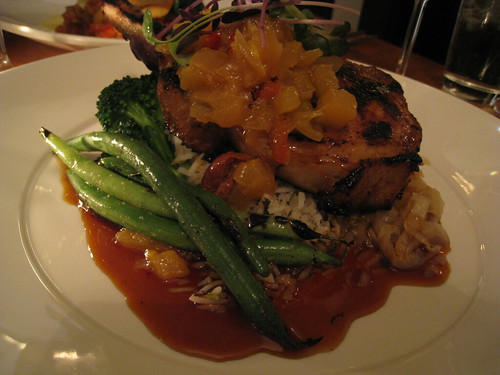
Our entrees took a bit longer than we would have liked, though I’m sure being the last table of the night didn’t help. My plate was stacked, my pork chop sitting high atop a bed of rice, vegetables, and garnished with a healthy amount of chutney. The Moroccan BBQ sauce was lovely (even though it tasted slightly like my Mum’s own sweet and sour base), and complimented the juicy, perfectly-cooked pork well. I made sure to soak up the rest of the sauce with my rice!


Pork

Mack was also happy with his char, though he said it was a tad over seasoned for his liking. The green beans were well-cooked as well.


Arctic Char

Dessert for me that evening was the warm chocolate cake, the same dessert I ordered on my other visit. It was the same as I had remembered – rich and sweet, my only wish was that raspberries were in season to accompany the cake.


Warm Chocolate Cake with Vanilla Bean Ice Cream

Mack’s blueberry and white chocolate bread pudding turned out to be better than both of us had expected. Not overly sweet, it appealed to Mack and ended his meal nicely.


Blueberry and White Chocolate Bread Pudding with Creme Anglaise

I’m happy I had the opportunity to try a three course meal at the Red Ox for a very reasonable $35 per person. As the server indicated to us that they only had one time slot remaining until next Thursday, we are sure many others will be treated to a great meal as well. Fork Fest runs until January 29, but many of the tables at choice restaurants will likely be booked solid (I would recommend taking a look at availability on Open Table, but calling to see if they have any cancellations if you really are intent on one particular restaurant).

Red Ox Inn
9420 91 Street NW
(780) 465-5727
Tuesday-Sunday 5pm-close, closed Mondays

My Wish List for Edmonton’s Food Scene

There are always things to be grateful for, and Edmonton’s burgeoning restaurant scene is definitely one of them. While I can’t say I’m actually a part of its development (commenting about it just isn’t the same as more active participation), it’s been wonderfully rewarding as a lifelong Edmontonian to see independent eateries and other food establishments successfully compete with chain restaurants.

At the same time, I know there are things in our dining scene that I would love to see – perhaps things that are percolating and forthcoming, but haven’t yet bubbled to the surface. In no particular order, here are some things I want to see more of:

  • One-note restaurants: It may be gimmicky, but places that serve one dish really well, such as Soul Soup or The Dawg Father, do attract attention. They are typically introduced to tourists as providing the “best” of something, and at the very least, force people to concentrate on one type of food, which may draw them away from their comfort zone.
  • Single word restaurant names: I was a bit disappointed with the recently opened Kai Asian Grill. I was really hoping the restaurant would grab “Kai” by the balls and just go with a single word to sell themselves to the world, but no, they copped out by adding “Asian Grill” to all of their signage. Yes, I know Edmonton has a number of restaurants that have one word names (Culina, Viphalay and Spago come to mind), but they don’t generate the same kind of excitement or mystery based on the name alone. Examples: Rouge (a contemporary French restaurant), Rush (a contemporary American restaurant) and Cilantro (which offers southwestern fare) in Calgary.
  • Food establishments as the hook for exploration: Beyond Chinatown and Little Italy, there are areas in Edmonton that should be explored on foot. Though food establishments generally become the bait to lure potential visitors to particular areas, they should not be the be-all-end-all of a visit. In April of last year, I wrote about a few walkable day trips that included food stops along the way – it was only a sample; I’m sure there are many others that I failed to include.
  • Innovative concepts: I was really excited when TZiN opened nearly two years ago. I really thought it would usher in a new age in Edmonton’s restaurant scene that would involve small, trendy establishments offering their own spin on dining. It hasn’t happened yet, but I’m still optimistic. Perhaps this means a charcuterie wine bar for Edmonton in the near future, but I’m sure the imagination of the city’s restauranteurs is greater than mine.
  • Year-round Farmer’s Markets: Summers in Edmonton are ripe with farmers’ markets (including my favourite one – the City Centre Market on 104th Street), but it’s a fairly depressing scene in the winter. There are only two approved farmers’ markets in metro Edmonton that operate year-round – Old Strathcona and Westmount – and one unapproved one at the Salisbury Greenhouse in Sherwood Park. Farmers’ markets are great places for people to learn about food and to feel a little more connected to the people who produce it, so it would be great to have more opportunities to do so, even in the winter.
  • Community gathering places: The Carrot, a volunteer-run coffeehouse on 118 Avenue, will be looked upon years from now as an inspirational model. Arts on the Ave, the organization behind The Carrot, has helped attract attention to the beleaguered neighbourhood by acting as a hub for community members to connect with one another, and by promoting local artists and causes. Edmonton could use more such initiatives.

What is on your wish list for Edmonton’s food scene?

Food Notes for January 19, 2009

  • Many of my food blogging cohorts have already sounded the Fork Fest horn, but I figured I’d echo their sentiment: $20 or $35 will get you a great pre-fixe meal at one of the city’s fabulous independent eateries under the umbrella of Original Fare. Check out the menu selections here.
  • I had the opportunity to interview Miles Quon of The Lingnan a few weeks ago before Family Restaurant started to air – my article was published in Vue on Thursday. I watched the second episode, which contained nary a coherent storyline. I am hoping the rest of the season doesn’t develop like this.
  • Liane Faulder published a great article this past week – the start of many “that will see local chefs lead Bistro through their favourite food haunts.” Kevin Ostapek, of Flavours Bistro was up first. Even better, Liane and Kevin travelled with a photographer, which meant there was a small online gallery associated with their trek – I always love seeing more visual representations.
  • The Journal also featured Eric Ng’s veggie donair in a piece about “fake food” on Saturday. Great to see Eric’s efforts recognized in mainstream media – I attended the world premiere of his creation back in November.
  • Ted Tsenekos, the owner of It’s All Greek to Me on Rice Howard Way, passed away last Sunday. My condolences to his family.
  • I passed by Sabzy Cafe (10416 82nd Ave) on Friday, personally noting for the first time that it was open, and lo and behold, a review came out in the Journal on Saturday. The family-run Persian restaurant focuses on fresh, healthy fare (including quinoa, the current “it” food of the moment), and got a thumbs up from the reviewer.
  • Culina’s temporary website is finally up, complete with links to their menus! I love the font and the coloured text on black, and the fact that the phrase “Culina Family of Restaurants” disguises the corporate nature of the establishments to some degree.
  • Poul Mark of Transcend Coffee wrote an intriguing blog post last week, musing about the “anti-wine model” that must be applied to premium coffee stores – instead of making a high-end product more accessible to the average consumer, premium coffee must convince customers to pay more for a fairly common (and cheaply obtained) product.
  • On a related note (from Mack), the St. Albert Gazette wrote about both Transcend and St. City Roasters, two locally-based coffee roasters. It’s a good introductory article that discusses some of the techniques they employ, but essentially, the conclusion is that home baristas will never be able to duplicate a fine espresso at home (at least not without intense training and months of practice).
  • More on coffee: via the Starbucks Gossip Blog, an article in Advertising Age that published the results of an online survey that says 60% of Americans have decreased their fancy coffee consumption in the last six months.
  • Diane Twittered her experience at a cooking/demonstration class called Culinary Date Night at Servus Credit Union Place in St. Albert this weekend – it’s $115 per couple, but might be an interesting alternative for a special occasion dinner.
  • I’ve been poking around Dollarama every now and then to see what they have in their food aisle (being the cheapskate I am), and it always surprises me with some of the “brand name” goods they offer. This last trip saw Uncle Ben’s rice, Wheat Thins (organic, nonetheless), and Honeycomb cereal. The following, however, I was skeptical about:


Poutine sauce in a can is frightening enough, so “poutine” sauce? Makes you wonder…

All-American Hot Dogs: The Dawg Father

I happened to be in the Alberta Avenue area on Thursday for work, and having read Liane’s article about The Dawg Father (8654 118 Avenue), chose that as my lunch destination that day.

Knowing that the joint specialized in hot dogs, I was expecting The Dawg Father to be somewhat similar to Tubby Dog, which serves up unusual condiments on a carnival favourite. In actuality, The Dawg Father reveres traditional toppings like onions, sauerkraut, cheese and relish. When I asked the proprietor Tom Stefura if he would ever experiment with things like wasabi and peanut butter, he said it wasn’t his intention to waver from classic, All-American flavours (partial menu here).

Order counter

The interior of the restaurant reminded me of a cleaner, modified Chicago Deep Dish – meant not for lingering, but to quickly satisfy one’s hunger. There are three new, glass-topped tables to provide those who need a place to stay, but it seems The Dawg Father also does a mean take-out business.

Tom greeted me as soon as I walked in the door. I asked for his recommendation, and after finding out that I wasn’t a fan of spicy foods, he said that the Baltimore Dog ($7.50) would be my best bet – topped with fried onions, cheese, and bacon. All dogs are served with coleslaw, ‘Ruby fries’ and a pickle. He asked if a ten minute wait would be all right, as all meals are made fresh. I had time, but I had to wonder – if several large groups came in all at the same time, the restaurant may not be able to accommodate everyone in a timely fashion.

I wasn’t keeping track, but I’m pretty sure my order took less than ten minutes to reach my table. I’ve never really considered a hot dog as anything beyond a snack, but The Dawg Father made me reconsider this, as my plate was definitely a meal in itself. The dog was drenched with a generous topping of sauteed onions, crumbled bacon, cheddar cheese and (unfortunately) mustard. Thankfully, the onions and cheese managed to negate the sharpness of my least favourite condiment, and I appreciated the heartiness of the all-beef wiener. The bread was fresh (they use buns from Handy Bakery just a few doors down), which is always a nice touch. The fries were a cut above, and made the overall price of the hot dog easier to reconcile. The potatoes had been freshly prepared with an aromatic mixture of garlic, parsley and salt – I was beyond full by the end, but I couldn’t imagine turning in a half-eaten plate that had obviously been lovingly prepared.

Baltimore Dog with coleslaw and Ruby fries

Before I left, I asked Tom why he had chosen 118th Avenue to open his restaurant, and whether or not the reputation of the area had deterred him at all. He replied that the media helped perpetuate the negative image of Alberta Avenue, and “if people think this is bad, try living in Newark, New Jersey.”

The Dawg Father
8654 118 Avenue
(780) 477-7947
Tuesday-Saturday 11am-7pm, closed Sunday & Monday

The Netty Series

My original intention at the Holiday Stop and Shop was to pick up an Ugly Doll to give as a gift. Of course, by the time I brought Netty home, I knew I had to keep him.

Inspired by this photo, I decided to have some fun with my new toy, and satisfy the twelve-year old in me. After taking the photos below, I found that Belua Designs’ creator, Sarah Bourque, has travelled with her own Ugly Doll, snapping photos along the way. You can check out Fremlys Big Adventures here, and keep up to date with Netty’s own shenanigans here.

Having breakfast

At work

Watching TV

Building a Kinder Surprise toy

Finished with  Kinder toy

Taking down the Christmas tree

Pointing out where he lives

Playing with dinosaurs

Reading a bedtime story

Sleeping