“A Very Sexy Party” at Eden Lilly

There was an intriguing invitation to something billed as “a very sexy party” in the latest Kerstin’s Chocolates newsletter I was sent last week. “A collective of likeminded business who like to have fun would like to invite you to share in something chic,” it went on. Among the businesses were Kerstin’s, Leva, Elegant Touches, To Be in Pictures, and Eden Lilly, where the party was to be held. Food and drink were to be expected, but beyond that, I didn’t know what to anticipate. Mack agreed to come with me, and off to Whyte Ave we went on Friday night.

I think the party was most interesting to me because the collective was outside of any established group, such as Keep Edmonton Original or Original Fare, but in my mind, was a great way to cross-promote each other.

When we arrived, we were greeted by someone at the door who checked our name off the guest list (150 people were anticipated, we were told later), and given two drink tickets. Cosmopolitans, wine, and beer were available, and we happily imbibed.

With my Cosmo

Eden Lilly was definitely not meant to house large groups of people for any lengthy period of time (the space was rather stuffy and humid by the end of our stay), but the organizers had done a great job in setting the atmosphere. A DJ had set up shop at the cash counter (which answered my question of whether or not we would be asked to buy anything), the lighting was perfect for a cocktail party, and beautiful flower arrangements were scattered on tables throughout the store.

The spread (containing a divine baked brie)

Kerstin’s had provided the chocolate for a self-serve fondue station, which involved dipping raisin bread into rich chocolate, then coating it with a choice of cocoa nibs. Yum!

Mack tests the fondue

We caught up with Roz from Eden Lilly later on in the night, and asked her what inspired the group to come up with such a unique event. She mentioned that customer appreciation was one factor, but also, as all of the businesses had similar goals (and likely similar clientele), that it was a good opportunity to host an event together.

Thanks to everyone involved for organizing a great party! I hope there are similar events in the future.

A Welcome Downtown Additon: Xtreme Asian Fusion

Being the avid diner that I am, when meeting up with friends for lunch, I am usually tasked with choosing the restaurant. Accommodating tastes and budgets are one thing, but the one-hour lunch in particular is always a challenging but fun obstacle to tackle, especially when location, a need for parking, and expediency are factors. Of course, my hunger to try new establishments is also a hurdle, albeit a personal one.

On Thursday, my friend agreed on my pick of Xtreme Asian Fusion (10508 101 Street), which seemed to satisfy all of the criteria. Speed was the only “X” factor (heh), but she and I were willing to take the risk. She picked me up and we parked in a row of free one-hour parking spots, and walked past my old volunteer haunt of the Boyle Street Co-op to reach the front doors of the restaurant. The location might seem a bit intimidating, but it really shouldn’t be a deterrent for anyone thinking about visiting the eatery.

The interior of the restaurant seems to fall in line with so many newly-opened or renovated Asian establishments that toe the line when it comes to minimalist décor and carefully chosen accent pieces. Xtreme’s design touches were light but well-chosen – paper lamps graced the ceiling, while interesting gold and metal wall hangings were attractive without being overbearing.

Interior

While the menu didn’t scream fusion to me, it did have the pan-Asian representation of both Vietnamese and Chinese dishes I’ve come to anticipate from a restaurant trying to appeal to a more Western palate. My friend and I both angled for the exact same Pad Thai dish ($11.95), which contained egg, shrimp, tofu and bean sprouts, among other things.

The service was great throughout – gracious and attentive, though the server who ended up delivering our dishes was definitely a bit of a showboat. As he was an older gentleman, it was actually quite endearing.

In no time at all, our plates arrived, with a smidgen of fanfare by our busperson. I’m not sure why we were floored by this, as there were only two other parties in the restaurant at that time, but we were duly impressed. Our plates were garnished with at least a half cup of chopped peanuts, much to my inner nut lover’s delight, along with quite a generous handful of shrimp. The heat in the dish was nice – contained, but enough spice to elevate the dish above bland. We had more than enough for lunch, and both ended up taking half our portions away with us. Our only complaint was that the noodles were too dry – water ended up being a necessary accompaniment.

Pad Thai

My friend wanted to make the most of our visit and try dessert as well, so we decided to share a plate of deep fried bananas ($4.95). Our final dish arrived, decorated with dollops of whipped cream, a healthy drizzle of chocolate sauce, and bite-sized morsels of the main star. My friend liked it, as it wasn’t overly sweet, and I found the batter nice and light. It did result in a rather sleepy afternoon, but I couldn’t complain.


Deep Fried Bananas

I asked our server if they were busy in the evenings, and he said no, something to be expected given the location. At the same time, he was optimistic that with the completion of the Epcor Tower in a few years, business would pick up. I hope Xtreme is able to bridge the tide – their efficiency and solid fare is a welcome sit-down addition to the downtown core.

Xtreme Asian Fusion
10508 101 Street NW
(780) 413-3338
Daily 11am-10pm, except Fridays and Saturdays 11am-11pm

Culinary Q & A with Courtney Jensen

Occupation:  Land Developer

What did you eat today? 

I had yogurt for breakfast with granola, flax seed and slivered almonds mixed in. I am going to New Asian Village for lunch, so I will eat tons of butter chicken and naan bread there (and a small token sampling of all the other dishes). My husband is making supper, so it is a mystery to me until I get home.

What do you never eat? 

I would say raisins, but I actually ate some in a salad I posted about while I was on vacation. I do not like them though, mostly because they remind me of bugs (they should never have told kids to eat ants on a log if they wanted them to LIKE raisins). I also don’t like processed cheese slices or cheese whiz or Velveeta because they creep me out a bit. I do eat most things though even if I don’t love them, if they are in a dish someone else has made.

What is your personal specialty? 

Things with peanut butter. People used to go nuts when I made peanut butter marshmallow squares – yes, the kind that are super easy and only involve four ingredients. I also do a peanut butter chicken marinade that seems to be popular. Other than that I think people like coming for dinner in hopes that they will eat something they wouldn’t make themselves.

Complete this sentence: In my refrigerator, you will always find:

margarine, milk, eggs, condiments (jams, ketchup, soy sauce, curry paste, pesto), cheese (usually four or five types), preserves (roasted red pepper, sundried tomato, artichokes), veggies, and frequently left overs. 

What is your weekday meal standby? 

I don’t really have a standby. Most of the time it is some sort of meat dish and some sort of veggie dish. Sometimes I will want something quick, so I go with a stir-fry or a pasta. In dire circumstances I make breakfast for dinner 🙂

What is your favorite kitchen item? 

My chefs knives (and santoku knife). They are super sharp and I love chopping things with them.

World ends tomorrow. Describe your last meal.

I would have to eat for hours! There would be lots of seafood, lots of cheese, and some curry. I suppose a good dose of peanut butter and chocolate would finish it off, and there would be wine with every dish, picked by someone that knows about wine, so not me.

Where do you eat out most frequently? 

I hit a lot of Indian buffets or sushi places for lunch, and for dinners I usually head downtown to one of the independent restaurants around. Some of my favorites are 4th and Vine, Red Ox Inn, and It’s All Greek to Me.

What’s the best place to eat in Edmonton? 

Right now I would have to say either Red Ox Inn or Sage (at the River Cree Casino), although Brooke raved about Characters after going there, I haven’t been recently enough to say.

If you weren’t limited by geography, where and what would you eat? 

I would go to Biarritz, France and see the woman that billeted my sister while she was there learning French, and just let her cook for me. When we were there she made us lots of food that was unreal, especially this one stew that had muscles and squid in it. It’s just great to eat local food done well by local cooks, and I like eating things that are different from what I usually make.

Courtney blogs at Take it and Like it.

Day 3 – Food: Today, Tomorrow, Together Conference

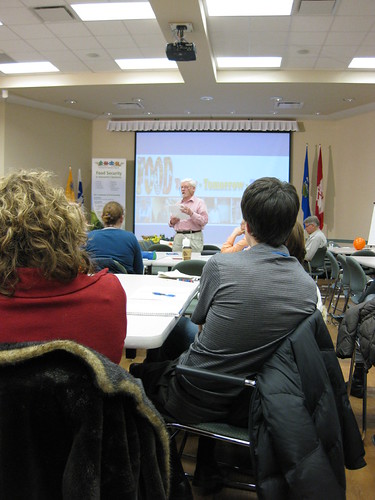
Day 3 definitely felt like a whirlwind, though I’m sure information overload was definitely starting to be a factor for me.

The morning started off with a keynote by Herb Barbolet, who is, among other things, an Associate with the Centre for Sustainable Community Development at Simon Fraser University. Partly due to the above disorientation, I can’t say I gained much from his keynote. He was supposed to, in part, summarize what we had learned over the last two days and provide a way for us to put our ideas into action, but I found his discussion mostly reiterated other writers and presenters without anything new. Barbolet was, in all, fiercely optimistic that change is on the horizon, and that the sign of society’s current resistance to change signals a death knell for the ways of current food production.

After the coffee break, we were treated to a lovely presentation by Animal Science 200 students from the University of Alberta, who, for the purposes of a class project are called “There’s a Heifer in Your Tank”. In small groups, they are tasked with creatively answering various agriculture and animal-related questions.  That morning, they tackled “Are French Charlolais bulls more romantic than other bulls?”

In a dating-show format, a “jersey cow” asked a series of questions to three “bulls” behind a curtain, to the audience’s comedic delight. Over lunch, the group also performed a short skit to discuss the positive attributes of horse and cow manure. Heifer in Your Tank has visited schools and community groups, using humour and an unusual approach to educate the general public.


There’s a Heifer in Your Tank

The last breakout session I attended, titled “Making a difference in the city”, was one of my favourites, because it was grounded with Edmonton examples. Ivor MacKay, an IT department worker with CBC, was asked by the network if he would subsist on a 100-mile diet for a week in Edmonton. He decided that a week wasn’t long enough, and after discussing it with his wife and children, extended it to a year starting in June 2007.

The 100-mile diet concept was popularized by Alisa Smith and J.B. MacKinnon from B.C., and focuses on obtaining all foods from a 100-mile (or 160.9km) radius. Ivor mentioned doing a lot of canning (so they would have, for example, tomato sauce in the winter), and missing certain foods (ginger, olive oil, vinegar). Most of all, they were prevented from participating in many social gatherings that centered around food (as restaurants, for example, used ingredients outside of their acceptable radius).

On the bright side, they built very close relationships with local producers, and using an analogy of a rainforest, where rain that falls is used up not only by the tallest trees, but trickles down to the plants on the ground, referenced building abundance in our local economy as one of the most important reasons to support area producers. Now, Ivor and his family are on the “bullseye diet”, which means they try to grow as much food themselves as possible, but buy whatever they cannot grow from local producers, then regional farmers, and so on. He is also working on a 100-mile diet cookbook.


Ivor MacKay shows us the 100-mile radius around Edmonton

Ron Berezan, also known as the Urban Farmer, presented about his passion for gardening. He emphasized the need to change the relationship people had with food (and increasing the ecological and agricultural literacy of the public), and  also drew our attention to statistics from Michael Pilarski that states that 1/10 to 1 acre of well-tended land can feed one person (as opposed to 9 acres per person through the industrial food system). He then proceeded to show us a “veritable pantheon” (TM Iron Chef) of urban garden examples: everything from community gardens, edible schoolyards and balcony gardens to urban livestock. Apparently, three backyard hens can produce up to two eggs per day, and Ron and the rest of The River City Chicken Collective, are trying to change the city’s animal control laws to allow chicken keeping. He also told us about an upcoming project in Strathcona County called the Emerald Hills Urban Village, which will strive to be sustainable and integrate an “edible landscape” into their plans. For those interested in urban farming, CityFarmer is the resource that Ron recommends.

The last session of the day was a final open space. Carol Off mentioned being a cynic, and I think I am as well, but I hope to be proven wrong. The last open space were meant to be action-oriented, and though I would love to see the groups continue on and flourish, to the point where they can report on having accomplished something by next year’s conference, the natural ebb and flow of a conference generally ends in all talk and no results. That said, I am excited about the idea discussed in the open space I joined – Andreas Grueneberg proposed a “local only” store in Edmonton that would sell nothing but locally produced goods year-round. He emphasized that this would have to be a citizen versus farmer-driven initiative, and some names and contact information were collected to initiate future meetings. It is an exciting idea that I definitely think there is a demand for, but with most endeavors, cautious optimism is the way for me.

After a few door prize draws, the 2009 Food: Today, Tomorrow, Together Conference was over. Two things really stood out for me by the end – the first was the wrought tension between the drive behind food security and money. Not one of the speakers I listened to referenced the declining economy, let alone mentioned the ‘r’ word, so I think the “elephant in the room” metaphor is appropriate in this case. As a majority of the speakers were calling for a radical purchasing shift by citizens, it really surprised me that no one acknowledged exactly how expensive and unrealistic that would be in the current climate.

Second, I had no idea Edmonton had such an underground of citizens passionate and committed to achieving food security (evident as a conference of this size would have never come to fruition otherwise), but they need to do a better idea of spreading awareness of their expertise to the greater public. Also, within this group, there is much work to be done to strike lasting and effective links between organizations – at the moment, it is very much a hodgepodge of parallel institutions.

Thanks to the volunteer committee for putting together a great first-time conference – the food was amazing, speakers insightful, and the opportunity to meet others interested in this idea priceless. One of the conference organizers told me that the capacity was 225, but that many more would have registered had there been room. I can only imagine the growth in interest citizens will have in this topic in 2010. Onward to next year’s conference!


2009 Food: Today, Tomorrow, Together committee

Food Notes for February 2, 2009

I’m taking a break from recapping this weekend’s conference for my regularly scheduled food notes, and to tell my readers that I likely won’t be continuing with my monthly post of Edmonton events. I didn’t put one together for January, and though I had some intentions to keep track of things for the month of February, it didn’t happen. My energies have converged into these weekly food notes, and between my other commitments, I don’t think I can do a good job. Luckily, in a few months, I think there will be a resource even better than my monthly posts. Keep your eyes open for ShareEdmonton!

On to this week’s notes:

  • The biggest news this week was Rob Feenie’s visit to Edmonton on Wednesday. He was in town to promote two things – his return February 11-13 to be NAIT’s first Hokanson Chef in Residence, and the mid-April opening of Edmonton’s first Cactus Club Cafe in West Edmonton Mall (I visited the Bentall 5 location last summer, and was blown away). The NAIT media team did an unprecedented job utilizing social media to engage the public, by live-Tweeting the event (answering questions live submitted via Twitter with the hashtag #naitchef), and taking behind the scenes video, which can be seen here. Be sure to enter NAIT’s Feast With Feenie contest on their website; deadline February 5.
  • My latest article about d’Lish, the newest meal assembly studio in Edmonton, was published in Vue Weekly this week. It’s one of my favourite pieces that I have written so far, if not only because Amanda gave me so much content to work with.
  • I came across a new-ish restaurant at the Taste of Alberta at the Today, Tomorrow, Together conference called Le Cafe Entre Amis (8627 91 Street, 780-395-0015), near the Faculte St. Jean.
  • The Hat will be offering brunch on Saturdays from 11am-3pm starting February 6.
  • I thought I might be able to write a full review of Michael Pollan’s In Defence of Food, but with the way things are going, I won’t. So in short: I didn’t find it as readable as The Omnivore’s Dilemma (mostly because it reads more like an essay as opposed to a narrative), though it is just as valuable a resource for those looking for facts to support a change in the way that they eat. It also surprised me that the end of the book was as prescriptive as it was – yes, he intended it to be a manifesto, but what I liked about Dilemma was that he left it up to the reader to shift perceptions on their own accord.
  • This is pretty cool: a printer that uses coffee grounds for ink!
  • Open Table, the online restaurant reservation site, filed for an Initial Public Offering today.

Day 2, pm – Food: Today, Tomorrow, Together Conference

After lunch, I was finally able to move from the auditorium into the more small-group friendly rooms for the day’s second breakout session. Titled “The Capacity of the Alberta Food System”, I was disappointed that the content didn’t actually provide more information about the capacity of the Alberta food system.

Candace Vanin, an agrologist with the Prairie Farm Rehabilitation, Administration, Agriculture and Agri-food Canada provided some interesting facts:

  • 8% of land in Canada is suitable for food production, with over 80% of that farmland positioned on the prairies;
  • Edmonton has a fairly good agro-climactic zone (rated 2H on a scale of 1-7, with 1 being excellent for agricultural activity), and has 143 frost-free days due to the geographic “bowl” the city is situated in; and
  • there are 170 census farms in Edmonton, and that 80-90% of all broccoli, cauliflower and beets in Alberta are grown in the Edmonton area.

Paul Cabaj of the Canadian Centre for Community Renewal talked about the results of a survey he conducted, but didn’t have anything particularly of interest to contribute except a mention of a social enterprise project. Apparently a group in Edmonton would like to start a greenhouse on the lands around the Alberta Hospital site to sell half of the produce to local restaurants, and use the profits to be able to provide the rest of the produce to low-income families.

Someone at the end of the session asked the obvious question – “What is the capacity of Alberta’s food system?”, and while neither presenter had an answer (partly because the answer would change yearly and be completely hypothetical), local economist Mark Anielski, who had participated in a panel discussion earlier in the day has estimated that Alberta would be able to support less than 10% of its population on its current agricultural production.

The last breakout session of the day was my favourite of the entire conference – the “Realities of Farming” offered two producers the opportunity to talk about their firsthand experience. Gene Brown, a small rancher with 170 cattle, was so honest and so well-intentioned that I wished that more people could hear him speak.

He talked about some of the changes they had implemented on their ranch over the last few years to make their farm more environmentally sound, including rotational grazing and water pumping. They also adapted some methods to reduce the stress on animals, like utilizing plastic nose paddles for seven days prior to separating the calf from its mother (meaning that they cannot receive milk from their mothers, but they have the security of being by their side for a week longer), and planting shelter trees along the side of their farm that borders the highway. Gene was very positive in his assessment of their farming business, saying that it was a lifestyle he would not give up, as it allowed him to be close to nature, and have flexible days. He closed his presentation with this: “Of all the crops we’ve produced, the ones we are most proud of are our children.” Aw.

Gwen Simpson, of Inspired Market Gardens was up next. She heavily emphasized how difficult it is for farmers to make a living in the current climate. She provided an example of her counterparts at Sunshine Organic Farm, who only make $2 per organic, pasture-raised chicken, and that doesn’t include the wages they have to pay to employees, insurance, certification, or transportation to farmers’ markets. Other notable facts:

  • Alberta lost 7.1% of their farmers (since which year, I didn’t note down). The average age of a farmer in Alberta is 52, and in the last 5 years, the province has lost 25% of farmers under the age of 35.
  • Canadians surveyed by the OECD ranked communication and health the #1 and #2 things they would be willing to pay top dollar for. Food ranked #11.
  • In 1988, 1.44kg of pork cost $6.88. In 2002, 1.46kg of pork cost $9.54, with the difference collected by the retailer and the processor, and not the farmer.

Gwen introduced the idea that perhaps farmers should be seen more as our doctors, as what we eat has a direct impact on our health. She noted that people should be willing to pay more for good food, especially if one considers proper nutrition as a means of disease prevention.


Gwen Simpson

We had another open space discussion prior to dinner, but for the life of me, I can’t remember which group I huddled around – being reliant on the notes in my Moleskine is a detriment to some extent.

I returned from dinner refreshed and ready for the final portion of the evening – a lecture from Carol Off, journalist, host of a CBC radio show, and author of Bitter Chocolate, a book that exposed the human rights violations of the cocoa industry. Immediately after her presentation, I was a bit disappointed with what I thought was a lack of content, but now, a few days later, I think it was a well-rounded case study of a commodity, peppered with people that she met throughout her visit to the Ivory Coast to investigate the situation.

“Food is the biggest story of our time,” Off opened. She gave a brief history of cocoa, and how it eventually became a prized commodity in the Western world. Her lecture then centered around the three factors that in her opinion led to the destruction of modern Africa and cocoa production: the greed and corruption of Africa’s leaders, the Structural Adjustment Programs heralded by the International Monetary Fund and the World Trade Organization, and corporate amorality by the multinationals that now “own” cocoa, and are able to drive down the price with their monopoly. On this last point, she explained, as farmers cannot afford to pay their employees because of the low rate they receive, they turn to the cheapest labour available – slave labour of children. Sadly, she even saw mothers purposely sending children into the Ivory Coast from neighbouring Mali – mothers that were hoping that being employed in cocoa plantations would guarantee them food they would not otherwise have. She herself does not eat anything but fair trade chocolate, or chocolate that contains cocoa sourced from anywhere but Africa, and reminded the audience, “When you take a bite of chocolate, just remember who’s life you’re eating.”

One of her suggested “solutions” to the problem was empowerment – of the cocoa farmers (to be able to organize, and to be aware of the true value of their product), and of us. She introduced the idea that would be rampant on day 3 of the conference that people need to stop viewing themselves as “consumers” – “The power to change lies with citizens and not consumers,” she said. Citizens can force the government to legislate the needed change – for example, introducing a bill that bans companies from importing cocoa farmed by children (in 2001, Senators Hawkin and Engel in the U.S. tried to pass what is known as the “Cocoa Protocol” to have done just this, but cocoa lobby forced their request to become voluntary only).


Carol Off

I was pretty beat by this time, but stopped in the cafeteria area to sample some included wine (from enSante, who, I am happy to announce, were granted an extension of their farmgate license and will be allowed to sell their wine at farmers’ markets this summer!) and cheese (from Sylvan Star Cheese, among others).

Day 2, am – Food: Today, Tomorrow, Together Conference

I did my best to try and blog on Friday night, but it seems my threshold for processing information was 10 hours. My cold didn’t help matters either, but now I have some catching up to do.

At any rate, the theme of day 2 was “what’s happening on local, provincial and national level”, and I think the committee did a great job of organizing sessions that addressed this topic. I started off the morning with a full thermos of coffee, the cinnamon bun I received yesterday at the Taste of Alberta, and a keynote by Elbert van Donkersgoed, Executive Director of the Greater Toronto Area Agricultural Action Committee. He talked about building blocks of a sustainable food system, with emphasis on farming just outside major cities – apparently, the value of production per acre is higher for farms closer to the city. Van Donkersgoed spent the initial few minutes deconstructing the notion of a “locavore”, and using statistics from an Ipsos Reid poll and a survey, tried to prove that though the locavore craved convenience, they are not just a passing fad. For example, 42% of Canadians reported in the poll that they had purchased locally-grown food in the last six months, 70% of the Royal Winter Fair patrons surveyed said that they change their diet seasonally, and 63% of the Fair patrons claimed they buy food based on where it comes from as opposed to the price. I was sceptical of these numbers, if not only because I think people respond to such question with the answer they think is “right” as opposed to the one that best describes their habits.

Van Donkersgoed argued that the business of farming needs to change to accommodate the rise of the locavore. He said that seasonality must be emphasized (to the point where consumers cannot get enough of the sun-kissed taste of a just-picked strawberry), consumers need to be educated on how to store fresh produce properly, and the structure of the food value chain (where supermarkets are currently the gatekeeper) must change.

He talked about Occombe Farm Store in the UK, which sells the produce of 40 local farms within 50km of the store. Situated on a conservation authority, residents can visit the farm not only to fulfill their shopping needs, but to reconnect with the land. The Edmonton Regional Tourist Group has organized opportunities for people to visit Edmonton’s countryside, but I agree with his point that urban sprawl must be reduced in favour of preserving (and ideally, increasing) the farmland around metropolitan centres.

It didn’t occur to me until he reiterated his points on Saturday afternoon, but van Donkersgoed was the only speaker that I heard over the course of the conference that wasn’t beating the drum of extreme change. Most of the speakers called for extreme shifts in thinking and practice, but for the majority of the population out there, such change just won’t happen. I’m glad van Donkersgoed expressed a more realistic (and small step) approach.

Our food-filled breaks began with a locally-sourced yogurt parfait – the yogurt was from Lacombe’s Bles-Wold Dairy, granola from Highwood River’s Highwood Crossing, and rhubarb and apple from enSante Winery. The granola, I should mention, was absolutely delicious.

Following the break, we reassembled in the auditorium for the first of three “open space” discussions. Attendees who had burning ideas were asked to lead table discussions and record the key points that had been brought up on flipchart paper. This was a good idea in theory, but with over 200 people in the room and only 6 volunteer leaders, needless to say, the groups were a little larger than they should have been.  Also, I could just see Mack shaking his head at the flipchart pages, and scolding that a wiki should be used instead. Apparently, the ideas will be collected and sent to all participants eventually, so hopefully some good will come out of them.

Wall of ideas

My first breakout session of the conference was called “Tensions in Food Security: promoting local food versus poverty”. Some points of interest:

  • 9.2% of Canadian households in 2004 were described as being food insecure, 2.9% of those being severe cases;
  • food banks, running on a supply versus nutritional need basis, fail to provide dietary adequacy, and their charitable model of program delivery makes it difficult for people to express unmet needs; and
  • the importance of food sovereignty and the need to “decommodify food” (Cathleen Kneen, of Food Secure Canada).


Valerie Tarasuk, Cathleen Kneen and Sherri Chisan wait for their turn to speak

Lunch consisted of a great mix of dishes – roasted bison au jus from Stettler’s Carmen Creek Bison, coleslaw, roasted potatoes and glazed parsnips and carrots from Edmonton’s Sunfresh Farms, a hearty bean casserole from Grainworks, barley fruit salad with barley from Progressive Seeds, bread from Bon Ton Bakery, and pastured butter from Bonnyville’s Johnson Family Farm. I felt bad for the chef at the bison carving station, who had to serve all hungry attendees, but he did a great job being patient with the demand. My favourite dish ended up being the glazed parsnips and carrots – simple but delicious.

Lunch

Day 1 – Food: Today, Tomorrow, Together Conference

The Food: Today, Tomorrow, Together Conference kicked off this evening at the Barnett House. The roads were sleek, and the icewalks (I mean, sidewalks) even more so, and though regretting my decision to walk to Barnett from Westmount Centre, I made it there soaked but in one piece.

Two things of note with this conference – they are striving to be a “paperless” conference, so attendees were not given any paper agendas (with organizers opting to project it onto a screen for everyone to see), and were expected to bring their own notepads for notes. Also, the majority of the keynotes and sessions will be filmed, so those who weren’t able to make it to the conference can see what they missed on the website.

Thomas Pawlick, author of nine books, including his most recent The End of Food, was the Conference’s opening keynote speaker. I have to say, one’s reception of his address has as much to do with the perspective of the listener as much as his words.

Thomas Pawlick

Having been introduced to the world of food security through Michael Pollan, I have to say that I probably wasn’t as receptive to Pawlick’s anecdotal-based speech. He talked a lot about small farmers he knew personally facing hardships due to competition with corporate industrial farms, and not being able to comply with provincial health regulations geared at shutting them down. He called it the “collectivization of Canadian agriculture”, and compared the current situation with what happened in the Soviet Union during Stalin’s reign.

He did bring some statistics into his lecture, including a brief overview over the “food tables” he had looked into – lab results analyzing the nutrients in everyday food items over the last 50 years. 100g of a whole tomato now, for example, has 22.7% less protein, 30.7% less vitamin A, 16.9% less Vitamin C and 61% less calcium than compared with the same quantity in 1963 – due largely to industrial farming methods that, among other things, do not breed for nutrients, do not allow time for optimum growth, and use only very basic fertilizer missing several essential nutrients (this really summarizes his point; Pollan elaborates much more in The Omnivore’s Dilemma on this latter subject).

Pawlick ended his talk with a call for action in the form of membership in two specific organizations – the National Farmers’ Union (NFU) and the fairly new Landowner’s Association. Non-farmers can join the NFU as an associate member to show support for their farming counterparts, and start city-wide chapters. The Landowner’s Association is meant to be more inclusive, but the scenario he described (which involved almost one hundred shotgun-wielding farmers surrounding police that had threatened to shut down a neighbouring farm) sounded too activist-oriented for my tastes.

As a whole, I was looking for something more concrete than stories. The Canadian context was great, but having Pollan and his statistics-based rhetoric in my head didn’t help matters either.

Next, we were invited downstairs to the cafeteria area for what they called a “Taste of Alberta”. It turned out to be an assembly of Alberta-based producers and food companies, all offering samples of products. The organizers had warned attendees that it wasn’t a full dinner, and to ensure that a meal was had elsewhere, but I am certain I could have filled up on the samples alone.

enSante Winery was there, offering five different samples of their wine. I tried one of their raspberry varieties, and it wasn’t as sweet as I was expecting – perhaps I will stick with their Adam’s Apple for a sweet glass. Le Cafe Entres Amis was offering a chocolate-orange crepe – one slice was definitely rich enough for me. 2 Greek Gals from Calgary offered an entire plate of food – Greek salad, spanakopita and chicken souvlaki. I’m not usually a fan of feta cheese, but I didn’t mind it at all in their salad. D’Lish and Sandy’s Country Kitchen were also offering samples, with the latter offering to pack up her homemade cinnamon buns for attendees to take home! My favourite dish of the night went to Rose Ridge Land & Cattle for the Beef on a Bun – so tender, I should have returned for seconds. My only quibble with the tasting event was that reusable cutlery, instead of plastic cutlery, should have been used to continue with the conference’s environmentally-friendly mission.

We ended the night with one of three simultaneous film screenings. I chose The Real Dirt on Farmer John (based on the title and nothing else). It turned out to be a documentary about John Peterson, the founder of Angelic Organics, an Illinois-based Community Supported Agriculture farm. It tells of his life growing up on the farm, his family’s history tending to the land, and his own struggles with supporting a farm in the current market. Being an eccentric person with an interesting life history definitely added some spice to the film, but what I enjoyed most was seeing how John related to the land, his community, and most of all, his mother.

Based on the first day, I am optimistic for how much more I can learn at the rest of the conference!

Food: Today, Tomorrow, Together Conference

It seems the extremes of Edmonton’s winter weather has caught up to me, so I will make this short and sweet. Tomorrow evening, farmers, food activists, concerned citizens, and everyone in between will be gathering at the Barnett House for the Food: Today, Tomorrow, Together Conference, running January 29-31.

I jumped at the chance to immerse myself in the topic and have an opportunity to be surrounded by those knowledgeable about the field of food security – something I’m only starting to learn about.

The sessions I am most looking forward to are the ones titled “The Capacity of the Alberta Food System” and the “Realities of Farming” – two topics that I would appreciate a local context to draw from. Of course, the Taste of Alberta on Thursday will also be a welcome palate pleaser, I’m sure.

I will do my best to blog each day after the conference, but it will depend entirely on the state of my cold.

The Cooking Chronicles: Banana Chocolate Pancakes

I had no idea the Food Network show Diners, Drive Ins and Dives had an accompanying publication until I stumbled upon it while on Amazon one day. As Mack and I love the show (and have to make sure we’ve already had a meal prior to watching an episode), we ordered up the book right away, and were keen to see which recipes he selected to include in the book.

It arrived last week, and while I didn’t have time to sit down and read it, I was surprised to find that the book was filled with more than just recipes – two-page profiles of choice establishments provided a context for the recipe, and potentially bridge readers who may not be familiar with the show.

Flipping through, I was intrigued by a recipe for Chunky Monkey Pancakes, knowing that there were overripe bananas and a can of orphaned whipped cream begging to be used. I modified it a bit, however, as Mack doesn’t like nuts, we didn’t have chocolate chips on hand, and wrapping an entire banana with a pancake didn’t make sense to me.

Instead, I drizzled Nutella in place of chocolate chips on the dollop of batter (a great trick that I only just learned that works so well versus trying to incorporate additives at the batter stage). It burnt a little, but was manageable. Also, I sliced the bananas and heated the cinnamon-dashed fruit in a skillet of melted butter, and Clinton Street-style, sandwiched the slices in the middle. I finished the plate with a dusting of icing sugar, tower of whipped cream, and more bananas.

Banana Chocolate Pancakes

These banana chocolate pancakes were definitely too indulgent for an everyday breakfast, but were a nice weekend treat.