The Anti-Cora’s: De Dutch

As much as I slag Edmonton’s lack of a brunch culture, in many ways, all it takes is a visit to Cora’s on a weekend to realize that actually, it is alive and well. Cora’s, the popular Quebec-based chain arrived in Edmonton back in 2009 with much fanfare. Those who had been to Cora’s were thrilled to have a familiar comfort in the city, while others were quick converts to the restaurant’s fresh fruit servings. Now with six locations in Edmonton, Cora’s has had pretty measured growth, though I’m certain the market could bear even more branches.

Preceding a matinee screening, Mack and I took Grandma Male for brunch late on a Sunday morning in November. We had chosen Cora’s for its proximity to the theatres in Sherwood Park, but in hindsight, it probably wasn’t the ideal option for us. The de facto waiting area was sardine packed and standing room only – a few chairs would have been nice for Grandma Male and others who weren’t comfortable on their feet.

Thankfully, we only had to wait about twenty minutes for a table – if Cora’s is anything, it’s efficient, with a constant stream of patrons heading in and out. That said, our meal on this occasion did feel a bit perfunctory, that we were a part of this great revolving door of weekend tables. While our server was nice enough (and did swing by to make sure our coffee was topped up), we weren’t wholly impressed with the food. Our toast was burnt and the fruit did not appear to be washed, and while my ham and swiss crepomelette ($13.55) was all right, it on the dry side. Mack’s Bobby Button crepe sandwich ($14.45) could have easily fed two people, but was nothing special.

Cora's

Ham and swiss crepomelette

Cora's

Bobby Button crepe sandwich

After that meal at Cora’s, I was even more looking forward to breakfast at De Dutch. Perhaps this Vancouver-based chain could offer a viable alternative to the stress and inconsistency of Cora’s?

While the owners of the local franchise may not want any comparisons drawn to Cora’s, their similarities make it difficult not to do so. Both are open only for breakfast and lunch, with expansive, family-friendly menus at a reasonable price point. And while De Dutch may appear more attractive at first because of its novelty, after my recent meal there, I think it is more than that – polished, professional and relaxed, De Dutch is the mature sibling to the juvenile Cora’s.

The décor of De Dutch is bright without being glaring, with a pleasant pastel colour scheme and a fireplace separating the two dining spaces. I particularly liked the cartoon maps of the Netherlands in the rear dining area. That Friday afternoon, the restaurant was a little more than half full.

De Dutch

Interior

There was one minor blip in service – some confusion upon arrival as to seating, as no one was at the hostess station and I had to flag down a server in the back room to request a table. The server did offer me a table at that time, but left me without a menu for a few minutes. It was fine, as I was waiting for my sister to join me anyway, but perhaps some better coordination is needed at the front of house.

The rest of our visit was smooth sailing though (and perhaps because of the initial glitch, we were treated to even more attentive service, with plenty of coffee refills and check ins). The menu at De Dutch is overwhelming, with scrambles, eggs benedicts, French toast, omelettes, burgers, and sandwiches in addition to their pannekoeken. I had my mind made up to try one of their signature pancakes, so it was easier to whittle down my choice. I decided on the hash pannekoeken ($13.25), in the mood for potatoes and hollandaise. Felicia opted for a smoked salmon, red onion and brie Dutch tostie ($12.50).

Our food arrived in good time. When my plate was set down in front of me I knew I had no hope, but I managed to get through half of the serving. The pancake in particular was notable for how light and neutral it was (making it perfect for either savoury or sweet flavours), and complemented the hash well. At first, I wondered why the hash was served in a separate dish atop the pancake, instead of being distributed on top of the pannekoeken, but as my leftovers were packed up, it made much more sense to keep the two separate (reheated two days later, the dish held up incredibly well – no soggy pancakes here!).

De Dutch

Hash pannekoeken

Felicia’s tostie looked almost dainty by comparison, but she enjoyed the toasted sandwich very much (and still had leftovers!).

De Dutch

Smoked salmon tostie

In contrast to Cora’s, we never felt rushed – on the contrary, we were invited to linger, with multiple coffee and water refills even after our plates had been packed up. While I recognize that part of this may relate to the fact that De Dutch is still relatively unknown in the city and hence not as busy yet (not helped by its lack of visibility from Jasper Avenue due to construction), I am optimistic they will be able to maintain their level of service even as their profile rises. So if you’re looking for a brunch option this holiday season – give De Dutch a try – I think you’ll be pleasantly surprised.

De Dutch
10030 Jasper Avenue
(587) 520-8841
Monday-Friday 7am-3pm, Saturday-Sunday 8am-3pm

Holiday Entertaining with Seasoned Solutions

Those of us who have committed to shifting our grocery spending to support local producers can probably attribute this shift to a number of reasons. It could be reading Michael Pollan’s seminal book, The Omnivore’s Dilemma, learning about factory food practices in the wake of the innumerable food safety scares (listeria, salmonella, E.coli, the list goes on), or watching the consequences of industrial farming unfold in Food Inc. For me, one of the memorable moments I can point to is attending Gail Hall’s inaugural Seasoned Solutions market cooking classes back in 2007.

While I wasn’t cooking on a day to day basis at that time, Gail introduced me to many of the producers that I now patronize on a weekly basis at the City Market. With her knowledge and passion, it is no surprise that Gail’s market cooking classes have become  a staple in the local food scene. That said, her philosophy of supporting local producers also perforates her other cooking classes, which include lessons centred around her culinary tours, and those that lend themselves to a particular time of year.

Two weeks ago, Mack and I had the good fortune to be invited to participate in one of Gail’s holiday entertaining classes free of charge. Inspired by some of the prominent food trends in Edmonton this year – namely, ethnic restaurants and food trucks – we would be cooking up a diverse menu of small bites and appetizers that anyone would be proud to serve guests.

The Seasoned Solutions classes take place in Gail and her husband Jon’s loft on 104 Street. Their home in the Cobogo Lofts is gorgeous – I am a sucker for exposed brick, but I also love their open concept plan. Their custom kitchen features a large butcher block island, and with the group of seven gathered around, it felt intimate and just right the right size for an evening of hands-on learning.

Seasoned Solutions Holiday Entertaining Class

Inside Gail and Jon’s loft

Because it would be several hours before we would be sitting down for dinner, Gail started us off with an artisanal cheese plate, featuring Sylvan Star gouda and cheese curds, The Cheesiry’s queso and Fairwinds Farm chevre.

Seasoned Solutions Holiday Entertaining Class

Cheese plate

Gail also whipped up a quick holiday apple juice spritzer, spiked with whiskey. Needless to say, I helped myself to a second glass.

Seasoned Solutions Holiday Entertaining Class

Cheers!

In preparing the recipes for the class, Gail met with the chefs and proprietors of all of the restaurants that inspired the menu, but of course, no one was forthcoming with their full recipes. But Gail, being the professional that she is, was able to piece things together based on some of the information they provided, and, well, numerous taste tests.

Mack and I were convinced that Gail’s recipe for chicken pesto calzones, if not a duplicate of Battista’s, are pretty darn close. Starting with a soft, supple dough that proofed for about an hour, each participant was able to assemble their own calzone, layering homemade marinara sauce, mozzarella cheese, and chicken tossed in an incredibly fragrant basil pesto. It was easily our favourite dish that night.

Seasoned Solutions Holiday Entertaining Class

Gail works the dough

Seasoned Solutions Holiday Entertaining Class

Assembling my calzone

Seasoned Solutions Holiday Entertaining Class

Calzones!

Given all of the components in some of the recipes, it wasn’t a surprise that Gail had to have some elements prepared already to expedite things. One example was cooled risotto, needed for the Corso 32-inspired arancini. As with the calzones, all participants had the opportunity to roll their own arancini, stuffing a cube of fontina within, and then dipping the balls in flour, egg and breadcrumbs. To cook the arancini, Gail shallow fried them – good news for us, as it means we are more likely to recreate them at home!

Seasoned Solutions Holiday Entertaining Class

Frying the arancini

Seasoned Solutions Holiday Entertaining Class

Arancini

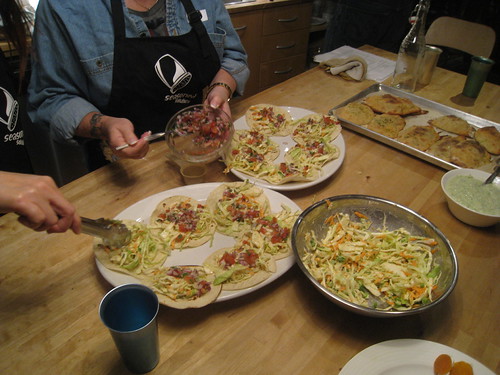
The most complicated dish was without a doubt the fish tacos, a take on Tres Carnales’ popular item. While the batter was easy enough to whip together (the secret ingredient being Mexican beer), the tacos also required coleslaw, pico de gallo, an avocado tomatillo lime sauce and warmed corn tortillas. It was great to “deconstruct” the tacos and understand how each of the components are made, but to be honest, I would probably opt to head over to the restaurant for my fill of fish tacos instead of attempting this labour-intensive dish. As expected, the final product was delicious, however, and I could imagine the tacos being the centre of a more casual gathering  at a taco bar assembly station.

Seasoned Solutions Holiday Entertaining Class

Assembling the tacos

Seasoned Solutions Holiday Entertaining Class

Fish tacos

In contrast, the Sofra-inspired goat cheese stuffed apricots were a cinch to put together, with Fairwinds Farm goat cheese piped into apricots. They could be served cold, or sautéed.

Seasoned Solutions Holiday Entertaining Class

Mack practices his piping skills

Seasoned Solutions Holiday Entertaining Class

Goat cheese stuffed apricots

Similarly, the pimento cheese spread was complete in five minutes. Gail, fresh from a tour of Charleston, South Carolina, said the dip was all the rage in the city. After one taste, we could tell why – the combination of goat cheese, pimento, mayo, cheese, Worcestershire, onion powder and paprika was deadly. This is definitely something we will be adding to our entertaining repertoire.

Seasoned Solutions Holiday Entertaining Class

Assembling the pimento cheese spread

After four hours of prep and cooking, we were ready to eat! The spread was pretty amazing, and I think I can say with confidence that everyone felt like they contributed to the dinner.

Seasoned Solutions Holiday Entertaining Class

The spread

Seasoned Solutions Holiday Entertaining Class

At the dinner table

I would definitely recommend Gail’s class – her enthusiasm for food and local producers is unbridled, as is her knowledge. With the small group, it was interactive, and Gail was great at multitasking in answering our questions, providing helpful tips, all while proceeding with the recipes. Mack felt it was the perfect balance between demonstration and hands-on opportunities, and with the detailed recipes we took home, even novel cooks would be able to recreate the dishes.

Although her Holiday Entertaining series has finished for the year, Gail has several classes scheduled for the new year (including market cooking classes starting in May 2013). Check her website for more information. Thanks again to Gail for the opportunity to participate!

2012 Christmas on the Square Holiday Light Up

The weather was actually pretty cooperative for Saturday’s Christmas on the Square, with temperatures holding out at a very reasonable –5C. It was a far cry from last year’s event, where the crowd was all dancing to keep warm.

Holiday Light-Up on the Square 2012

Crowds gather

There were several vendors on hand to round out the festivities. It was good to see Big City Sandwich and Eva Sweet, but the biggest line was easily awarded to the mini doughnut trailer (I have to say I consider mini doughnuts a summer food, but given the salivating crowds, perhaps the WinterCity Strategy should specifically name this treat as a method of drawing crowds outdoors).

Holiday Light-Up on the Square 2012

Big City Sandwich

A new addition to the program this year was Booming Tree, a Japanese drumming duo. Although their act was mostly only tangentially related to the holidays (festive lights around the drums can only go so far), I really enjoyed their act. It was a pleasant change from the usual Christmas music.

Holiday Light-Up on the Square 2012

Here’s Santa

Speaking of music, when Mayor Stephen Mandel eventually retires, he should become a stage crooner. He was more than comfortable with the microphone in his hand, belting out a carol to welcome Santa to the city.

Though it has been a few years since they brought out the giant switch that “turns on” the lights on the Christmas tree, I kind of miss that over-the-top kitsch. Still, it’s also nice to be a part of a group to collectively marvel over the lovely displays.

Holiday Light-Up on the Square 2012

And it’s on!

As usual, the fireworks were timed to music, emphasizing style over the quantity of poppers. I’ve said this before many times, but I really wish other fireworks shows took a cue from this production – it is always so much more enjoyable than a seemingly random smattering of sparklers.

Holiday Light-Up on the Square 2012

Fireworks!

The tree will be lit until early January – so even if you missed the light up, you have several weeks to pay it a visit.

Holiday Light-Up on the Square 2012

Christmas is near…

Kudos to the organizers for another great event!

South West Sophistication: XIX

Restaurants are made up of many factors. The ones most often referred to include menu, service, decor and ambiance. But location is frequently left off that list, in spite of the fact that it contributes to the overall experience of the establishment. Convenience, ease of access, and neighbouring attractions do determine, to an extent, the frequency with which a diner returns.

That’s why it was curious to me when it was announced that Chef Andrew Fung’s new venture, Nineteen, would be located in the far-flung southwest neighbourhood of MacTaggert. Although Nineteen is located within the same quadrant as his most recent restaurant, the Blackhawk Golf Course, there is probably more to be said about being first to the post. Nineteen is breaking new ground in an area of the city dominated mostly by chains, and brings more sophisticated dining to suburban residents who may be accustomed to commuting for a refined meal.

Still, in anticipation of a complimentary preview event on Monday evening, I was most looking forward to how Chef Fung would “redefine dining” (Nineteen’s catchphrase). Without much in the way of surrounding street life or a critical mass of restaurants, the expectations for Nineteen are high – in order to attract patrons outside of the immediate area, the restaurant has to be considered a dining destination.

For us, it was a bit of a harrowing journey to Nineteen. From our downtown home, it took us over an hour’s drive to reach the restaurant, the Whitemud at a crawl due to two accidents. It was a reminder of why we generally don’t venture beyond a certain perimeter in a vehicle, especially at rush hour, but we recognize that it was an experience isolated to us among the diners that evening. As a result, we were late for the start of the tasting, but happy that we fortuitously ended up seated with Edmonton Sun columnist Graham Hicks and his lovely wife, Maria.

Our first impressions of the restaurant were positive. The dining room connotes warmth, achieved through a combination of the incandescent light fixtures and the organic, leather material throughout the space – in wall panels and gold-coloured chairs. It felt almost like a smoking lounge, comfortable, but polished. Nineteen also has a lounge, dressed similarly and separated by a wall.

Nineteen

Dining room

That said, my favourite feature of the dining room was the open window into the kitchen. It’s always great to have a visual connection with those preparing your food, and at Nineteen, clearly they have nothing to hide.

Nineteen

Peek into the kitchen

The menu sampling was generous, with ten separate courses served over a span of three hours. The dishes were to give us an idea of the breadth of the menu, though the final version for the restaurant’s opening night of November 7, 2012 was yet to be finalized. We were told that the menu would likely change on a bi-weekly basis, to allow for the inclusion of seasonal and rotating dishes. At least on the menu presented, there weren’t any local suppliers highlighted, though I didn’t have a chance to ask Chef Fung if this would change.

Our favourite dishes were served in the first half of the meal. Among them was the one-bite ahi tuna twist, with a surprisingly fiery finish, and gloriously fatty blueberry duck sliders with chipotle aioli.

Nineteen

Ahi tuna twist

Nineteen

Duck sliders

Chef Fung also showcased quite a bit of his flair for seafood. His miso marinated Atlantic salmon was bright and briny, a flavour carried on in the wasabi miso dressing on the accompanying spinach salad. Mack really enjoyed the ahi tuna & scallop ceviche, gorgeously presented on a pedestal with fresh thyme crackers. The ponzu and wasabi pea foam were subtle but ideal enhancements.

Nineteen

Miso marinated Atlantic salmon

Nineteen

Ahi tuna & scallop ceviche

The Japanese baby back ribs were also a hit around the table, glazed with sake soy. They had just the right amount of sweetness for my palate, and the meat easily flaked off the bone, textured with the right amount of fat.

Nineteen

Japanese baby back ribs

Less successful was the confit chicken waffle. The sweetness of the grilled peppers were the highlight among the muddled flavours of chicken and the quinoa-potato waffle. As well, the duo of Alberta pork featured an overly dry tenderloin, and an undercooked, chewy king oyster mushroom.

Nineteen

Confit chicken waffle

Nineteen

Duo of Alberta pork

Without a doubt, Chef Andrew Fung has crafted a menu that plays to his strengths, which include incorporating Asian ingredients in inspired ways. But what I guess I was hoping to find at Nineteen was a more defined identity, one that would occupy an upscale niche not yet found in Edmonton to help make it the destination restaurant in an otherwise bleak independent dining district. For example – Corso 32’s obsessive approach to Italian cuisine, or the refined interpretation of a steakhouse by Charcut in Calgary. Of course, as I mentioned above, perhaps it doesn’t matter – Nineteen’s niche may simply be serving upmarket cuisine in an area starved for it. Only time will tell.

Thanks again to Chef Fung and the staff at Nineteen for the invitation. Best of luck in these opening weeks!

Nineteen
5940 Mullen Way

Check out some other perspectives of the evening from Linda and Chris.

Date Night: Highlands Kitchen and Carriage Ride

I feel a bit sheepish posting this so late, especially because the restaurant has since changed hands. But Mack encouraged me to do so anyway, as it does provide a snapshot of a great neighbourhood-based date. Plus, the restaurant has turned over to another independent company, so the bones of the evening are still very much a possibility.

At the end of July, Mack and I took the bus over to the picturesque neighbourhood of Highlands, the only community in Edmonton that we know of where you can have dinner followed by a carriage ride.

We started our evening at Highlands Kitchen (which has since become the location of Creole Envie). This was our first visit since its transformation from Culina Highlands, but we understood the menu preserved the Eastern European comforts that had been its hallmark.

We chose to sit outside on the charming patio, lined with herb planters and shielded from the bustle of 112 Avenue. For dinner, as has become custom for us, we decided to share several dishes, all of which we enjoyed.

Highlands Kitchen

Patio

Mack’s favourite was the bacon wrapped dates ($10), swayed as he was by the sweet-salty touchstones. My favourite were the pork crepes ($12), featuring tender pulled pork in a Saskatoon berry BBQ sauce.

Highlands Kitchen

Bacon wrapped dates

Highlands Kitchen

Pulled pork crepes

The quinoa salad ($12) was also noteworthy, as it became the inspiration for several subsequent salads of my own. I loved the different textures in every bite – from crispy chickpeas to sweet cranberries and crunchy seeds.

Highlands Kitchen

Quinoa salad

For dessert, a simple but delicious pound cake topped with berries and a scoop of Pinocchio ice cream. Perfect for two to share.

Highlands Kitchen

Eating it too

After dinner, we headed up the block to Mandolin Books to pick up our reserved tickets for the horse-drawn wagon ride with Anjl Horse & Carriage Company. Those who have frequented the Alberta Avenue and Highlands Farmers’ Markets might be familiar with the proprietor behind Anjl – Arie Jol is a resident of Highlands, and vends meat and eggs under the banner of Ma-Be Farms.

The rides start from the bookstore on the last Friday of every month, approximately every half hour between 7-9pm. They take place year round, so long as the temperature holds above –15C. Our adult tickets were $10 (teens are $8, and seniors and children 12 and under are $5).

Highlands Horse & Carriage Ride

Anjl Horse & Carriage

The ride was a leisurely one, though perhaps not as educational as we would have hoped for. Arie isn’t a historian, but given he had been conducting these tours for some time, we thought he would have been able to answer more of our questions about the neighbourhood.

Highlands Horse & Carriage Ride

Sharing the road

Still, he did point out some neat features, such as plaques that had been put up on buildings in the area by the Highlands Historical Society, indicating the home’s original residents or business.

Highlands Horse & Carriage Ride

Plaque on Mandolin Books

As well, Arie made sure we were able to get a good look at the homes of Highlands’ founding fathers. One in particular, the Macgrath Mansion, is absolutely stunning.

Highlands Horse & Carriage Ride

Macgrath Mansion

That summer night, with the canopied streets in full bloom, Mack and I marvelled at how unique it was to be riding through the streets of Edmonton in a horse and carriage. Only in Highlands.

Highlands Horse & Carriage Ride

Horses!

2012 Sturgeon Valley Food & Wine Festival

The newest food and wine festival on the scene is the Sturgeon Valley Food & Wine Festival, held this past Saturday for the very first time. Given the rising number of these types of events, it was very important that the Sturgeon Valley edition differentiate itself somehow. At first glance, it definitely edges out the others in terms of venue. The Enjoy Centre, with its glass ceiling and gorgeous sconces, outdoes both the Shaw and Expo Centre.

Sturgeon Valley Food & Wine Festival

Sturgeon Valley Food & Wine Festival

Mack and I were invited to attend for free, and were also lucky enough to receive $20 in sampling tickets. That said, I am not sold on this model (which is the same as the Rocky Mountain Wine & Food Festival), which charges admission cost and additional dollars for sampling tickets. As a patron, I’d much rather pay a steeper ticket price for an all-inclusive event.

For our admission period of 4-6:30pm, we found the crowds a bit sparse, but this was to our advantage – no lines, ample seating, and we felt we had more time and space to converse with the reps. I know at the Rocky Mountain Festival in the past, I have felt a bit claustrophobic at times, and somewhat rushed at certain tables with others jockeying in for samples.

Sturgeon Valley Food & Wine Festival

Enjoy Centre (can you spot Phil and Robyn?)

There were about two dozen liquor and food vendors, but only three tables sampling wine. This was likely due to the fact that the festival ran over the same weekend as Co-Op’s Grape Escape, which featured sixty wine and spirits producers.

Because wine was not as prominent, it definitely drew our attention to the range of beers and spirits highlighted. Notably, this was our first encounter with Ribstone Creek Brewery, which, although no longer Alberta’s newest beer (that distinction probably belongs to Hog’s Head now), we were happy to learn about. It seems the founder wanted to build some sort of business in his hometown of Edgerton, Alberta, and settled on a brewery. It has already won some awards (silver for best domestic lager at the Calgary Beer Fest), and based on our taste, did find it to be quite a light beer (even for me, as a non-beer drinker).

Sturgeon Valley Food & Wine Festival

Ribstone Creek Brewery

We were also introduced to Solstice Botanical Vodka, a new vodka distilled by Yukon Brewery, which makes it the first craft brewery in Canada which is now also a craft distiller. The company wanted to make a unique spirit that combined herbs and berries available in the area, and with the guise of a local herbologist, steeped raspberries, rosehip and sage with the vodka to create the final product. It was noticeably smoother than more mainstream vodkas, though still probably a bit too harsh for me to sip straight up.

Sturgeon Valley Food & Wine Festival

Solstice Botanical Vodka

The first of the two wine vendors we patronized featured BC wine blends from Backyard Vineyard under the name Nosey Neighbour. Both the red and white we tried were pretty easy drinking wines.

Sturgeon Valley Food & Wine Festival

Nosey Neighbour

On the other side of the spectrum was Chinese Happy Wine. A blend of white wine and Osmanthus flower, the vendor described it as a dessert wine. While it was sweet, the lingering aftertaste was not a memorable one (I also had to wonder at the price point – I’ve never seen a dessert wine priced at $8.70 a bottle).

Sturgeon Valley Food & Wine Festival

Chinese Happy Wine

Of course, we were also able to try some of the food offerings. Most of the restaurants represented are located in St. Albert, great for us given we don’t often frequent eateries in that area. First up was a teaser of mac and cheese and baked beans from La Crema Cafe and Smokehouse. Mack commented on the Velveeta-like consistency of the sauce, but we both really enjoyed the smoky-sweet beans with bits of bacon stirred in.

Sturgeon Valley Food & Wine FestivalSturgeon Valley Food & Wine Festival

Mac and beans from La Crema Cafe and Smokehouse

Darcy’s Meat Market enticed us with their display, and we chose to try their applewood smoked pulled pork slider and handmade beef jerky. Neither was the most elegant to consume at an event like this, though we did our best. The slider could have used more sauce to bind and flavour the meat, while I prefer my jerky a little more dehydrated.

Sturgeon Valley Food & Wine Festival

Honey garlic jerky and pulled pork slider from Darcy’s Meat Market

The star of the food samples was from The River House (though I don’t have a usable photo, unfortunately). Their braised short rib was hot, tender and delicious.

As a whole, we had a great experience. The Sturgeon Valley Food & Wine Festival has ample room to expand, both in the areas of food and drink. That said, hopefully they can manage their growth and maintain their great hospitality and the intimate nature of the event. Thanks again to the organizers for the invitation!

Mercury Opera’s Fiamma

On Friday night, Mercury Opera turned a downtown parking lot on 104 Street into a veritable opera stage. You may remember Mercury Opera from their innovative 104 Underground event last year, that saw a live performance orchestrated on the LRT platform of the Bay/Enterprise Square station. This year, Director Darcia Parada brought the opera out and onto the street with Fiamma (Italian for “flame”).

Mercury Opera's Fiamma

Performers at the Eyecare Group

It wasn’t clear on the website what the “gala” preceding the performance entailed, so we had a full supper before purchasing the $25 tickets at the Armstrong Building. At that time, we were given a passport that would be honoured at nine different locations around 104 Street for drinks and treats.

Mercury Opera's Fiamma

Mack tries on some velvet shades at the Eyecare Group

We didn’t end up having enough time to patronize all of the sites, but were able to sample from several of the businesses. The flow of food and drink was much more controlled this time around when compared with the 104 Underground as we had to redeem our passports to imbibe and eat.

Mercury Opera's Fiamma

The crowd at Dauphine

We enjoyed the return of Skinny Legs and Cowgirls (now as a “roaming chef”, or caterer), who served tasty wild mushroom crescents, snacked on fresh pretzels from Cook’s Corner, and satisfied our sweet tooth with cupcakes from Delish. I think the organizers did a fantastic job of engaging small caterers and businesses to supply the food for this event.

Mercury Opera's Fiamma

Skinny Legs and Cowgirls

Evoolution also participated, serving sweet concoctions of drinking vinegar and club soda. We’d heard about this use for their flavoured vinegars, but hadn’t tried it ourselves yet. It was definitely an interesting spin on an Italian soda.

Mercury Opera's Fiamma

Evoolution

It was great to see Amber’s Brewing Company out and about, serving their first batch of beer produced at their new location of Hog’s Head in St. Albert.

Mercury Opera's Fiamma

Jim Gibbon of Amber’s Brewing Company

At 8pm, we gathered in the Melcor parking lot, admiring the lights that transformed the space. Then, led by a stilt walker, paraded down the Alley of Light to the other side of the parking lot.

Mercury Opera's Fiamma

Parade

A cube van was curiously parked in the lot, but the mystery was soon revealed – the back door rolled up and exposed the musicians gathered inside. With that, the show began, a spotlight directed at an opera singer situated on the top of the Armstrong Block fire escape.

Mercury Opera's Fiamma

All the world’s a stage

The performer must have been freezing, but didn’t show it at all, her voice penetrating the cold night.

Mercury Opera's Fiamma

Spotlight

The show progressed to include other performers, located in the lot itself, and elevated slightly on mechanical lifts. At this point, the vantage point for spectators suffered a bit. The risers helped, but for any audience members not situated in the front row, the view was obstructed by the parking arch.

Mercury Opera's Fiamma

An aerialist from Firefly Theatre

But in a way, the location couldn’t be as perfect as a typical opera stage because of its guerrilla nature, and it was a suitable trade-off for this unique presentation of opera. Vibe Tribe, known for their fire dances, was a great inclusion, adding more visual interest with their flaming displays.

Mercury Opera's Fiamma

Fire and song

With the rousing applause granted to the performers at the conclusion of the show, there was no doubt the crowd enjoyed Fiamma! We can only look forward to whatever Mercury Opera dreams up next, but surely, it will again be opera “where you least expect it”. Bravo!

Date Night: 104 St Grill and Edmonton Opera’s Storm the Stage

Since Ric’s Grill became 104 St Grill earlier this fall, Mack and I have been meaning to give this new incarnation a try. I had signed up for the electronic mailing list early on, which entitled me to a $60 gift certificate, really giving us no better excuse to have dinner there. We finally had the chance to do so on Saturday.

We arrived just after it opened, and were seated in a booth towards the back. What struck us most at first was how the interior remained remarkably unchanged. Sure, the bar area was a little more open, but the rest of the space retained its formality. I guess it was most surprising because we had heard that the location was originally in talks to become Soda Jerks, but when that didn’t pan out, I assumed the final plan for 104 St Grill would still based on a more casual upscale model, instead of nominal adjustments.

104 St Grill

Interior

The menu, however, in both dish selection and price really communicated that not much had changed at all. Entrees, ranging from $17-29 were very traditional plates, and really didn’t excite or interest us. We instead chose to share several of the starters.

The best of the four appetizers was no doubt the poutine ($11), though not named as such on the menu. The potatoes was prepared well, flecked with crunchy bits of bacon.

104 St Grill

“Poutine”

The risotto ($12) was quite a generously sized appetizer, served with an (overdressed) side salad. Again, the bacon popped, and the risotto was creamy enough, but not exceptional.

104 St Grill

Risotto

The carrot and ginger daily soup ($6) had a great texture, smooth but with some body, though I was hoping for a little more zing. The order of Brussels sprouts ($10) was probably enough for four people, but could have probably used a bit more of the brown butter sauce.

104 St Grill

Carrot and ginger soup

104 St Grill

Brussels sprouts

Although service was professional and attentive (we were familiar with the server from The Copper Pot, which used to be in the same family of restaurants), 104 St Grill just doesn’t offer a menu that would invite us to return on a regular basis. Only time will tell if the rebranding will result in success, but for us, it isn’t the type of restaurant we would frequent in the neighbourhood.

After dinner, Mack and I headed to the Jubilee Auditorium for Edmonton Opera’s annual Storm the Stage party. Though we’ve attended a few of Edmonton Opera’s productions in the past, I will admit that it is an art form that hasn’t appealed to us as strongly as others. That said, we have enjoyed Mercury Opera’s attempts to make opera more successful (with another, Fiamma, coming up on October 26, 2012), and was curious about Edmonton Opera’s attempts at trying to broaden their audience.

Storm the Stage

Aida set

I’d read that Storm the Stage was literally that – an opportunity to have party on the set. It seemed like a great behind the scenes peek, though we weren’t really sure what to expect.

Storm the Stage 2012

Treats from Duchess

Well, that’s not entirely true – I suppose we anticipated some opera-related content, especially given the audience may not often frequent opera productions. As a result, the highlight of the evening for me was the two short performances by two members of the Edmonton Opera chorus.

Storm the Stage 2012

Edmonton Opera chorus members

Given we were on the gorgeous set of Aida, in the shadow of an imposing sphinx, it really would have been neat to have a tour of sorts, learning how the set designer came up with his ideas and executed them (I did want to run up and touch the “statues”). It seemed like a missed opportunity to connect the audience with the show in a more direct way.

Storm the Stage 2012

F & M

That said, the evening was enjoyable enough, with performances by alternative folk trio F & M and the always energetic and engaging Mitchmatic. Thread Hill also put on a fashion show, utilizing the tiered stage as a visually interesting runway.

Storm the Stage 2012

Mitchmatic

Storm the Stage 2012

Thread Hill fashion show

Mack mentioned that the evening could have been improved with a host to unify the performances. It was a little strange that both F & M and Mitchmatic had to introduce themselves, while the fashion show and opera performance just seemed to spontaneously begin.

In all, it was an interesting experience, though one that could have used more opera.

104 St Grill
10190 104 Street
(780) 429-4333

Edmonton Opera

Thoughts on Fresh: Edmonton’s Food and Urban Agriculture Strategy

On September 30, 2012, the City of Edmonton released Fresh: Edmonton’s Food and Urban Agriculture Strategy. It was a document fifteen months in the making, drafted primarily by an advisory committee made up of fifteen members, with some consideration of public input contributed through other channels.

Although a majority of the strategic directions put forward in Fresh address food purchasing, preparation, consumption, celebration and waste, much of the discussion in the media and online has only touched upon the strategies related to peri-urban agriculture, more specifically in this case referred to as the northeast farmlands.

Mack has done an exceptional job filtering through the premise behind the land debate, and I would refer you to his blog for an overview of the history and analysis of the development question. But it is important that the food-related portions of the document are not overlooked – after all, the strategy tries to address more than just agriculture.

That said, I am very disappointed in the food-related strategic recommendations. I recognize it is easier to criticize than to create, but I did participate in the online survey and one stakeholder consultation, and am a little astonished that this was the best they could come up with. They claim if the “Strategy’s Recommendations are adopted, the City of Edmonton will be well positioned to be a leading example for municipal food and urban agriculture initiatives” (23). But if that were true, I think Fresh would have taken more risks and aspirations instead of reading as the flat, mostly vague document that it is.

Of course, much of my criticisms below can be attributed to the short timeline permitted for the development of the strategy, as well as the failure to include some of the key members of the city’s food community in the consultation process. But still, given Fresh is what the Executive Committee will vote on at the non-statutory public hearing on October 26, 2012, this is what we have to go with.

What Fresh is missing

  • Recognition of work already being done: Mack and I never expected to have What the Truck?! mentioned in Fresh given it only began in 2011, so it was a surprise to find our festival acknowledged in the recommendation relating to enlivening the public realm. As a result, it is an even larger failure of the strategy to omit two other longer-standing volunteer-based groups working towards food production and food recovery. The first, the River City Chickens Collective, proposed a backyard chickens pilot to City Council back in 2010. They were rebuffed because of the forthcoming development of the food and agriculture strategy which would be considering this, among other potential urban agriculture ideas. The resulting recommendation in this strategy, developed two years later? “Examine opportunities for citizens to keep bees and raise hens” with the specific action reading, “Partner with local non-profits to assist in the evaluation of the implications of allowing urban backyard hens” (33). The Collective is not only in the same place it was in 2010, but Fresh doesn’t even go so far as to recommend backyard hens; instead, it chickens out with a loose directive of further study. The second relates to “Develop partnerships to assist in the redistribution of healthy, fresh and high-quality surplus food” (46). Operation Fruit Rescue Edmonton (OFRE) has been run by dedicated volunteers since 2009, gleaning excess fruit from backyards and donating a portion of that surplus to charitable organizations. Fruits of Sherbrooke, with a similar mandate but a smaller catchment area, started in 2011. It would be natural to link them to the recommendation of expanding existing gleaning initiatives, but both OFRE and Fruits of Sherbrooke are conspicuously absent.
  • Stronger emphasis on food skill development: if one of the underlying objectives of Fresh is to help increase the demand for locally grown and raised produce and proteins, it is logical to conclude that encouraging food skill development (i.e., how to cook and prepare fresh foods) is vital to achieving that goal. We know that we are failing to provide basic food preparation education to young people, which leads to a greater reliance on processed foods. Although this is not an easy problem to tackle (and involves broader issues such as commodity subsidies, food deserts, and income disparity), Fresh barely acknowledges the importance of food skills. The sole recommendation reads, “Work with the Edmonton Food Council and various partners (such as NAIT, the University of Alberta, and Northlands, among others) to provide multiple learning opportunities on key food and urban agriculture topics and initiatives” (28). What does “work with” mean? Would these “multiple learning opportunities” be affordable and accessible? Although NAIT and the U of A have permitted rentals of their facilities for food skills sessions run by Eat Alberta in the past, they have never offered reasonably priced sessions to the public on their own accord – how would the City propose to change this (e.g. with grant incentives)? Not only is this recommendation vague, but it appears the committee did not take the time to articulate the implications.
  • Link to food justice: although the broader definition of food security is somewhat addressed in Fresh (i.e., the ability for an area to feed its citizens in the event of an interruption to the food system), none of the strategies highlight food justice and how those with low or fixed incomes can access local food. Save the recommendation relating to the gleaning and redistribution of surplus food (46), the strategy is strangely silent on this issue. I understand it is difficult to represent all possible interests and perspectives, but it is curious that not a single recommendation explicitly targets the empowerment of food insecure individuals and families.
  • Opportunities to learn from and celebrate immigrant and Aboriginal food culture: given the growing number of immigrants choosing to settle in Edmonton, and the increasing population of urban Aboriginals residing in our city, it is a glaring omission that there are no recommendations that encourage learnings from either of these minority groups. There is a nominal mention of “Engaging…immigrant group associations to participate in celebrations and events” (43), but it fails to address that many of these small organizations are struggling to operate, and without support aren’t readily able to take on new initiatives. Enhancing our knowledge of diverse food practices and acknowledging the wealth of experience in our community should be a pillar of the strategy, not a token, an idea reinforced by Kathryn Lennon of the Multi-Cultural Health Brokers.

What Fresh is lacking

  • Action-oriented, clear language: what most struck me in my first reading of Fresh was its lack of a backbone. The committee was charged with making recommendations, which City Council can, in theory, accept, reject or modify. So I wasn’t sure why, in countless instances, where recommendations could have started with direct, action-oriented words such as “create” or “partner” or “initiate”, we instead are left with non-committal recommendations such as “Explore the creation of an Edmonton Food Charter” (25) or “Identify urban agriculture opportunities in existing and developing neighbourhoods” (32). To me, the weak language is a greater indication that the strategy as a whole needs to be reworked.
  • Big, thought-provoking ideas: was it too much to hope for that the food and agriculture strategy could excite people? Get Edmontonians thinking about the possibilities, or at least generating a healthy debate among citizens? I recognize that many of the recommendations were inspired by other cities, and while I am not arguing for a reinvention of the wheel, Fresh could have included at least a few more creative, off the wall suggestions. Instead of the non-binding “Encourage developers to provide land and infrastructure for urban agriculture” (32), how about recommending that the City force developers to earmark green space for community gardens, or pledge to double the current inventory of community gardens? Or, while it might be a start to “Increase local food purchasing within City of Edmonton operations” (40), wouldn’t it be great if Councillors led by example and committed to “go local” one week every year by ensuring at least one meal per day was primarily made up of locally-sourced ingredients (similar to the Transit Riders Union of Edmonton’s week-long transit challenge). Even more revolutionary, offer some sort of economic incentive through a tax break for restaurants that source at least 20% of their ingredients from local farmers (thereby encouraging demand for local product, perhaps even allowing restaurants to lower menu prices because of the incentive). Sure, such ideas may not ever pass through Council, but they would at least spur discussion, necessary to engage citizens on these issues.
  • Addressing the ambivalence towards supporting local: Fresh seems to take for granted that at present, the vast majority of Edmontonians do not support local businesses and producers, or at least do not deliberately do so. Yes, we have made great strides in the past five years, especially in the local restaurant scene, but for every new small independent that opens, several more chains pop up in the city. Or, as Jennifer Cockrall-King pointed out in a recent panel discussion, spending at farmers’ markets is estimated to be a measly 1% of food household expenditures. Arguably, there are other means to access farm direct products (e.g., CSAs, produce box deliveries), but as a whole, I think it is safe to say a majority of Edmontonians source groceries from a large grocery retailer. Oft-cited deterrents for not supporting local farmers include cost (something Kevin Kossowan has debunked), convenience, and selection, but there is another reason at play that isn’t often discussed. While Mack and I were in Portland last month, we were blown away by the level of pride demonstrated by the locals about their food community at Feast, a festival highlighting the bounty of Oregon. From farmers and winemakers to salt miners and chefs, it was incredible to witness such an embrace and ownership over local proprietors. Edmontonians by nature are a self-depreciating bunch, quick to play down our assets and draw attention to our flaws. Worse, a majority remain strikingly indifferent towards supporting the home grown producers and independent businesses that are unique to our city. We truly do need to heed strategy 5.5 of growing local food supply and demand (39), but how? None of the recommendations address the fundamental question of how to cultivate the pride that ultimately translates into solid financial support for the local food economy.

While the food strategies are less contentious than those surrounding land use, they are no less important. New York-based chef Gabrielle Hamilton remarked at an event recently about “poor little food” – how food is being asked to cure all societal ills, from environmental concerns to health and family morale. But the truth is, food is a unifying factor that can ignite positive change.

If Fresh is passed, I remain optimistic that moving forward, a body like the Edmonton Food Council could help further articulate the actions that need to be taken by the City, particularly with regards to food skill development and partnerships with existing organizations. Food can be that spark for change – we just need to set the right parameters for it to help us enrich our community.

City Market 2012 Winter Season Kick-off!

Although the City Market shifted from its 104 Street location last week to Churchill Square (as a part of the Olde Time Fair on the Square), today marked its first date inside their winter home of City Hall.

City Market 2012

Inside the City Room

Mack and I arrived at the tail end of the market, but the selection of fresh produce was still very good (we picked up the last of Steve & Dan’s blueberries, for instance). It also looks like there is a new vegetable vendor this year – Erdmann’s, who would be familiar to those shoppers who frequent the St. Albert, Callingwood, Festival Place and Mill Woods markets.

City Market 2012

Erdmann’s

The City Market did a great job of posting vendor maps for the 104 Street market – I am hoping a similar list will be cropping up for the winter edition. The signage was also lacking today – no sandwich boards could be seen, either directly outside City Hall or at Churchill Square directing patrons towards the market.

City Market 2012

Great to see a fair number of vendors!

The City Market inside City Hall runs from 10am-3pm every Saturday (except December 22 and 29, 2012) until May 18, 2013. Hope to see you there!