The Cooking Chronicles: Pasta Cravings

When I crave pasta, I can think of having nothing else. I’m not sure what it is – the carb lover in me, the association of comfort – but when it hits me, there’s no question what we’re having for dinner.

This week, we tried out two new pasta recipes which were quite different from one another. But they both hit the spot, and satisfied my craving.

One-Pot Macaroni and Cheese

Alberta Milk’s recipe for a one-pot macaroni and cheese stretches the truth, because in reality, it calls for at least an additional bowl or vessel used to blend the sauce. But it didn’t matter that night because after staring me in the face for twenty days (since flipping to “March” on our fridge calendar), I was making that mac and cheese one way or another.

We used a food processor to combine the milk, old cheddar, flour, mustard and seasonings, which we added to the prepared pasta. Heated for a few minutes, the sauce thickened up nicely, and dinner was done!

One-Bowl Mac and Cheese

One-pot macaroni and cheese

Mack even commented that this was better than KD – and it didn’t take that much more time to prepare, either!

Pasta Primavera

I was flipping through Giada De Laurentiis’ very first cookbook, Everyday Italian, the other day, and her recipe for pasta primavera grabbed me. Yesterday, anyway, it did resemble spring outside, and a bowl bursting with sweet, roasted vegetables seemed like a good way to commemorate it.

Sliced August Organics onions, Peas on Earth carrots, zucchini and bell peppers were tossed with olive oil and herbs, then roasted in a hot oven for over twenty minutes. I actually ended up leaving the vegetables in the warm oven longer while I prepared the rest of the ingredients, and it just helped matters, intensifying the flavours even more.

Pasta Primavera

Roasted vegetables

I cooked up some Sunshine Organic chicken to add some protein to the dish (given it was intended to be a meal and not a side), and instead of cherry tomatoes, just used some whole Doef’s tomatoes we had on hand. Tossed together with some of the pasta liquid, plus some chicken stock that I had deglazed the cooking pan with, it was one of the best pasta dishes I have made in some time.

Pasta Primavera

Pasta Primavera

The caramelized vegetables were so sweet – the onions had nearly melted away, while the zucchini, carrots and peppers were soft and tender. It was a light meal, but still quite satisfying.

One of the pasta dishes I can’t wait to make is seasonal in nature (and depends on access to fresh, ripe tomatoes), but summer’s just around the corner – I can’t wait! Are there any pasta dishes you crave?

Culinary Q & A with Twyla Campbell

Occupation: Food and Travel Writer, CBC Edmonton AM Restaurant Reviewer

What did you eat today?

Liberté strawberry yogurt for breakfast, beef satay Bánh mì from V’s Sandwiches. Supper is going to be nasi goreng with five spice duck breasts using Greens Eggs & Ham duck.

What do you never eat?

Brain.

What is your personal specialty?

I’m a wicked soup-maker—a skill I got from my mama.

Complete this sentence: In my refrigerator, you will always find:

olives in a jar; you never know when there’ll be a martini emergency you need to tend to or an antipasto platter that needs to be whipped up.

What is your weekday meal standby?

Steak. Usually yak/beef cross from Real Deal Meats.

What is your favourite kitchen item?

A hand forged Masakage chef knife from Knifewear in Calgary, but I also love my onion goggles.

World ends tomorrow. Describe your last meal.

First off, my husband would probably be having his own “last meal” with Charlize Theron, so the fact that a semi-nude Adam Levine would be serving me has to be taken in that context. That being said, Adam would serve up a Dusty dry Victora Gin martini to go with an amuse bouche of sea urchin (uni). After that it would be a starter of charred octopus from Stamatis Greek Restaurant in Queens, NY, followed by a 24 ounce Bone In Rib Eye steak from Vic & Anthony’s in Las Vegas with some juicy Tuscan tomatoes drizzled with Poranino olive oil from Chianti. For dessert, Adam would (obviously) spoon feed me Callebaut Chocolate Mousse from Narayanni’s in Edmonton. All of this would be washed down with a bottle of Night, a cab sauv/cab franc/merlot blend from my favourite Okanagan winery, Ex Nihilo. If the world is going to end, I’m going down in a blaze of protein and alcohol—with a side of Levine.

Where do you eat out most frequently?

Pho & Bun in Forest Heights. Best peach shrimp in the city.

Where’s the best place to eat in Edmonton?

Tres Carnales. Fantastic food and a great vibe. A hug from Daniel makes all things right in the world, Chris has the corniest humour ever, and Edgar—who my daughter calls Saint Edgar—is a wizard in the kitchen.

If you weren’t limited by geography, where and what would you eat?

I’d return to Italy, specifically to Susan McKenna-Grant’s agriturismo, La Petraia, outside of Radda in Chianti. Anything Susan makes is spectacular and the constant aroma of rosemary and lavender is balm for the weary soul.

Twyla blogs at It’s a Weird, Wild and Wonderful Life.

Chef Connie DeSousa at Appliances Unlimited

Just in time to launch the second season of Top Chef Canada, Calgary-based Chef Connie DeSousa of CHARCUT was in Edmonton last Sunday to help promote the kick-off, as well as one of the show’s major sponsors. Appliances Unlimited, one of two vendors in the city that offer the GE Monogram line of appliances, hosted the appearance. The hour-long session saw Connie demo not one, but two dishes.

Connie DeSousa at Appliances Unlimited

Chef Connie DeSousa

The Edmonton Journal’s Liane Faulder did a wonderful job of mc-ing the morning, asking Connie a variety of questions spanning her career, time on Top Chef, and home cooking habits.

Connie DeSousa at Appliances Unlimited

Liane Faulder on the mic!

Five things I learned about Connie that I didn’t know:

  1. She has a background in ballet.
  2. If she had a choice, she would take on Bobby Flay on Iron Chef America.
  3. Hot chocolate is her vice.
  4. Her favourite home appliance is her immersion blender and stand mixer (plus all of its attachments).
  5. She has dined at both D’Lish and Corso 32 in Edmonton.

Connie demoed two applications of her recipe for homemade goat cheese. The first was a goat cheese-topped roasted beet salad. This dish really showcased CHARCUT’s philosophy of “evolving simple ingredients” – trying to highlight the best of what quality, local ingredients have to offer.

Connie DeSousa at Appliances Unlimited

Roasted beet salad with goat cheese and lemon-infused olive oil

I particularly liked her second dish, a no-bake cheesecake that layered preserved cherries and graham crackers between the whipped goat cheese. At CHARCUT, these desserts are served in half-cup mason jars, but whatever the vessel, I could see myself making this at home!

Connie DeSousa at Appliances Unlimited

No-bake goat cheese cheesecake with cherry preserves

Edmontonians might be seeing more of Connie in the near future. We asked her about rumours that Charpop (CHARCUT’s wildly successful pop-up restaurant concept that took Calgary by storm) would be setting up shop in Edmonton, and though she wouldn’t confirm (or deny), I’d like to think it’s a safe bet with the number of fans she has in this city.

Connie DeSousa at Appliances Unlimited

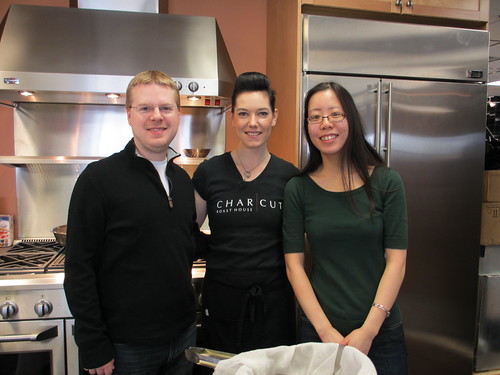
Connie with two of her fans

Thanks again to the event organizers for the invitation!

You can take a look at my full photoset here. Liane and Chris recapped the demos as well.

Announcing Eat Alberta 2012: Your Real Food Survival Guide

It feels like our inaugural Eat Alberta conference was only a few months back, but it took place almost a year ago! Based on the response we received the last go around, we knew there was an appetite in the city for more opportunities to learn about local food and to connect with other like-minded individuals, so a second incarnation was definitely something the organizing committee wanted to offer.

Eat Alberta

We also took the feedback we received from the first event very seriously; the most common response was that future conferences should be held in a professional kitchen. We’re very happy to announce that this year’s conference will be held at NAIT, which features some of the best culinary facilities in Edmonton. Attendees also made suggestions about the type of sessions they would have liked to have seen on the schedule, and as a result, we have done our best to invite chefs and producers to match the requested content.

Eat Alberta 2011

Kathryn Joel is back again this year with another pasta making session

Valerie took the lead on developing the schedule, and has made sure there are a variety of both hands-on workshops and tastings for participants to choose from. I think there is something for everyone, and more than a few classes that I’d like to slip into if I had the chance! This year’s sessions include:

  • Keynote from Shannon and Danny Ruzicka from Nature’s Green Acres, who will be sharing their farming story and addressing why grass-fed meats are better;
  • Operation Fruit Rescue Edmonton’s Amy Beaith will be sharing her knowledge on preserving fruits and vegetables;
  • Patty Milligan (aka Lola Canola) will be returning with her fabulous bee education and honey seminar (it was the only session I had time to partake in last year, and I can say from firsthand experience that it is not to be missed);
  • ever-energetic Prairie Mill’s Owen Petersen will be showing aspiring bakers how to farm their own yeast; and
  • Kevin Kent, owner of Knifewear, is travelling from Calgary for sessions on knife skills and sharpening.

You can take a look at all of the session descriptions here.

Eat Alberta 2011

Tasting honey with Patty Milligan

Tickets were released to the public this morning, and I know some of the sessions are filling up fast! Tickets are $135, and include the keynote and panel, four sessions, breakfast, lunch and a glass of wine.

Eat Alberta 2011

Allan Suddaby (who is also on the organizing committee) is passionate about sausage!

So to get your first choice of sessions, head over to the registration page soon – we’d love to see you at NAIT for Eat Alberta 2012: Your Real Food Survival Guide, on April 14!

Sobeys’ Apple Challenge at NAIT

Though apples are generally most associated with the fall, the time of harvest and going back to school, in the Prairies, their cellar longevity means they are one of the few fruits we can consider “seasonal” throughout our long winter. As a result, the BC Tree Fruits Association wants to bring apples top of mind at this time of year, and has declared February to be Apple Month.

To help celebrate this, Sobeys worked with a number of local institutions to help spread the word, which included a donation of 1500 apples to Prince Charles School to ensure students would have access to healthy snacks. Sobeys also partnered with the culinary school at NAIT for an Iron Chef-style challenge that invited students to contribute their most creative uses for the fruit basket staple. On the line: $1,000 in prizes.

NAIT Apple Challenge

Busy kitchen

A total of thirteen students in their first and second year of studies submitted recipes to NAIT Instructors for consideration, and out of that, eight students were chosen to compete. On February 11, 2012, students were given one hour each to prepare their dish which would be judged by a panel of food writers. I was lucky enough to be asked to join this panel, alongside Liane Faulder and Valerie Lugonja.

NAIT Apple Challenge

With Liane and Valerie

Prior to the tastings, we were allowed to interact with the students while they were creating their signature dishes. We were told that they were permitted to prepare some things ahead of time, such as sausage or pastry dough, but that most of the cooking would be done that day.

NAIT Apple Challenge

Paulina Klassen focused on her rugelash

Surprisingly, nearly all of the students had chosen to make savoury dishes, smashing my preconceived notion that we would be sampling a variety of pies and crisps.

NAIT Apple Challenge

Pan finishes up her soup vessels

NAIT Apple Challenge

Christina Schell tosses some brussels sprouts

Of course, I should have given the students more credit than that – after talking to a few of them, it was clear that the versatility of the apple was what drew most of them to the competition.

NAIT Apple Challenge

Ren Ping Pui works on his cheesecake filling

Unfortunately, we weren’t able to watch most of the students finish and plate their dishes, as we had to begin the judging process. Rapid-fire, we would be tasting eight dishes in forty minutes – the three of us were definitely up to the challenge!

NAIT Apple Challenge

Ashley Broad starts to plate her dishes

We were provided with a score sheet that would enable us to award each dish with up to 20 points: up to 10 points for taste, 5 points for presentation and 5 points for creativity. Valerie commented that other categories could have been added – such as awarding points for their verbal presentations – for some students, their ability to clearly articulate their cooking philosophy and inspiration provided a better background and context for the dish.

First up was Ashley Broad, who prepared a roast duck and apple tart. I appreciated the combination of the two flavours, which worked really well together. The pastry itself was a little too firm for my preference, but the apples were cooked really well.

NAIT Apple Challenge

Roast duck and apple tart

Second was Pan Pan, who happens to be Miles Quon’s wife. She presented a charming curried apple soup (served inside a cored granny smith!) alongside a grilled apple salad. The soup itself was a bit on the sweet side, but had a nice smouldering back heat. I found the salad to be overwhelmed by the prosciutto, but Valerie really adored the vinaigrette it had been tossed with.

NAIT Apple Challenge

Curried apple soup with grilled apple salad

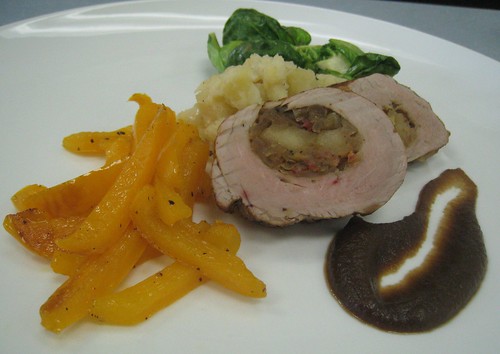
Christina Schell’s apple stuffed pork tenderloin with an apple parsnip mash was a plate with many components. All of us really enjoyed the apple balsamic puree, but found the pork to have been overcooked. We also thought the dish could have used more focus on the apple and less on extraneous ingredients.
NAIT Apple Challenge

Apple stuffed pork tenderloin

Next up was a pork in apples with herbed chevre, cremini mushrooms and apple and peach puree from Chloe Lomas. Out of all of the students, Chloe was the most eloquent in terms of verbalizing how she was able to translate her vision onto the plate (she had wanted to represent an apple in nature, so replicated the “soil” using mushrooms). Her creation was incredibly layered, in terms of both flavours and textures.

NAIT Apple Challenge

Pork in apples with herbed chevre, mushrooms and apple and peach puree

Terry McNeil presented apple sausage with apple slaw, cheese crisps and cranberry apple compote. Terry had made the sausage herself (having arrived at Culinary Arts through the meat cutting program), but we found it to be a bit dry, and in need of more fat. That said, the slaw was quite refreshing, and I loved the crumbled cheese crisps on top.

NAIT Apple Challenge

Apple sausage with apple slaw

With the only pure dessert of the competition, Ren Ping Pui’s crispy pancetta cheesecake filling with apple compote, apple crumble, apple sorbet and berry kissel sauce was a welcome taste. Calvados (apple brandy) had been cleverly incorporated throughout the dish – in the sorbet, the filling and the compote, but it wasn’t evident, taste-wise. Without a doubt, the cheesecake filling was heavenly, whipped to a mousse-like consistency, though Liane and Valerie found that the pancetta overpowered the delicate flavour. Ren’s plate was the instructor’s favourite, because of the intricate technique that had been used.

NAIT Apple Challenge

Crispy pancetta cheesecake filling with apple compote, apple crumble, apple sorbet and berry kissel sauce

Krystle Duquette flexed her skills with molecular gastronomy by making apple caviar to serve with her glazed apple and frisee salad. Apple juice, maple syrup and agar were dissolved then dripped into freezing cold canola oil, to produce delicate pearls. They didn’t work as well as she had hoped, but it wasn’t the main component of her plate. Her cinnamon heart-candied apple absolutely popped (definitely appropriate for the forthcoming Valentine’s Day), and we loved the crisp frisee salad, brightened with a vinaigrette made with cider vinegar and honey.

NAIT Apple Challenge

Glazed apple and frisee salad

Last but not least was Paulina Klassen’s savoury apple rugelash. The pastry was amazing, buttery and melt-in-your-mouth, with a richness from bacon fat that had been added to the dough. The sweet, caramelized apples and an underlying layer of jam paired with the rugelash perfectly, though the addition of candied bacon didn’t hurt either.

NAIT Apple Challenge

Savoury apple rugelash

In the end, though our scores didn’t match, our ranking of the dishes was consistent. We awarded first prize to Paulina’s rugelash, second to Krystle’s glazed apple and frisee salad, and third to Pan’s curried apple soup and grilled apple salad. The winning recipes will likely be printed in a Sobeys publication in the future, such as the fall issue of Compliments.

Thank you again to Sobeys for the invitation to be a part of this competition! It was the richest breakfast that I’ve had in some time, and the most enjoyable, too. Best of luck to all of the students in their studies – their creativity and energy was inspirational and contagious. Long live the apple!

You can see the rest of the photo set here.

The Cooking Chronicles: Cooking with Bulgur

Amy Pennington, in Urban Pantry, describes bulgur as the “gateway drug for whole grains” due to its ease of preparation and wide availability. I have to admit that bulgur wasn’t really on my radar until recently, after I bookmarked a few recipes that featured bulgur in the ingredients list. I picked up a bag from the bulk section of Save-On, and have been working my way through the recipes with varied success.

Quickly Stewed Tomatoes and Sausage with Bulgur

Mark Bittman rarely lets me down, but he did with this recipe. Part of it had to do with my expectations – I was anticipating a less soupy consistency, hoping that the bulgur would plump up and absorb most of the liquid.

Quickly Stewed Tomatoes with Sausage and Bulgur

Stewed tomatoes and sausage with bulgur

That wasn’t the case, and the result was a stew containing bulgur that didn’t really add anything to the dish.

Meat-and-Grain Loaf

Bittman made up for the disappointment with the next recipe we tried, one for a meat-and-grain loaf (I considered it a major victory when Mack asked for a meatloaf that was lighter on the meat).

We had a pound of Nature’s Green Acres ground beef, and mixed it with some reheated chopped, frozen spinach, diced onion, garlic, egg, cooked bulgur and seasonings. I knew my proportions were off, as I had added way too much spinach and bulgur, but I thought it would work out in the end.

Grain and Meat Loaf

Meat-and-grain loaf, with cabbage and lemon salad

The loaf came out fine, but because of its size, required over an hour and a half to cook in the oven. It was undoubtedly the healthiest meatloaf we had ever made, and with the grains and vegetables in each bite, could have been a meal all on its own. I also liked the use of bulgur in this way, adding some additional nutrients in place of breadcrumbs.

Bulgur & Citrus Salad

I’ve mentioned in the past that I do my best to prepare vegetarian dishes for potlucks at work (because many of my coworkers have meat-related dietary restrictions), so I was eager to try a recipe for bulgur & citrus salad in Urban Pantry for this purpose.

Bulgur was without a doubt the star ingredient, livened with the inclusion of pine nuts, parsley, mint, dried currants, orange zest, orange juice, red wine vinegar and some olive oil. I found, however, that to get the “sweet-citrusy pop” that Pennington described, I had to double the amount of zest and juice. It resulted in a fragrant salad, but perhaps not the most ideal consistency, as the bulgur was almost mushy.

Citrus and Bulgar Salad

Citrus & bulgur salad

After sitting overnight in the fridge, the sweetness intensified, but it didn’t help the bulgur. More herbs, added to freshen up the salad at the last moment would have been a good idea, too.

I haven’t given up on bulgur yet – what are your favourite uses for the grain?

The Cooking Chronicles: More with Legumes

As I have mentioned in the past, I’ve been trying to incorporate more legumes in our diet. The biggest difference this year is that I am actively trying to lessen my reliance on canned beans. Although we will likely still keep a few on hand (they’re great in a pinch), dried beans are cheaper, I can then control what goes into them, and they are free from the BPA that is present in the lining of cans.

I think I only cooked dried legumes twice all last year, but so far in 2012, I’ve already made three batches. With some planning, I’ve found it not to be a burden at all – I soak them before leaving for work, cook them that evening, and then have them ready to go for the following day. I’ve been freezing the leftovers in small bags, so they’re handy for future meals. We’ll see how long I am able to continue this, but in the meantime, I am still determined to try new recipes that feature legumes.

Mexican Fried Rice

Our go-to fried rice involves eggs and barbecue pork, but the Mexican version in Julie van Rosendaal and Sue Duncan’s Spilling the Beans with chorizo, black beans, tomatoes and cheddar seemed like it was worth a try.

The black beans definitely fortified the dish, but even with the chorizo, it wasn’t quite interesting enough. I think it would have made a difference if I had a cast iron pan that was large enough to accommodate all of the rice (charring it would have added a lot of flavour). As well, the rice would have also benefited from other spices – cumin was the dominant (and only) fragrance. 

Mexican Fried Rice

Mexican fried rice

Moroccan Chickpea Stew

The fruit in the ingredients list drew me to this Moroccan chickpea stew – with both apples and dried apricots, I wasn’t sure if the final product would end up much too sweet.

Thankfully, the answer was no. In addition, the apricots cooked down to the point where they more closely resembled the other softened vegetables, and with the chickpeas, it made for a light but satisfying supper.

Moroccan Chickpea Stew

Moroccan chickpea stew

Dumpling and Chickpea Stew

Our last attempt at dumplings failed miserably, but I did want to try another recipe at some point. Given the previous dumplings lacked flavour, Daphne Oz’s inclusion of cornmeal in the batter of her recipe piqued my interest. She also chose to highlight this recipe as a dish she would include in her “last supper”, so it had to be good, right?

We learned from our previous experience that the size of the dumplings matter, so we made sure to form smaller ones in the simmering soup. The cornmeal did add some interesting texture, and as a whole, I think they were a success – moist and light as they were – and most importantly, they cooked all the way through! The dumplings also helped thicken the broth somewhat, which, paired with the chickpeas, made it a heartier dish.

Dumpling and Chickpea Stew

Dumpling and chickpea stew

I’m just not sure it would be last supper material, at least not for me.

The Cooking Chronicles: “Urban Pantry”

Another cookbook I received as a Christmas gift this year was Urban Pantry: Tips and Recipes for a Thrifty, Sustainable & Seasonal Kitchen. Mack said the book had mostly positive reviews online, and after my initial read, I can see why.

Author Amy Pennigton provides her ideas on what should make up one’s pantry essentials, taking into consideration the limited space apartment dwellers face, and the needs of a home cook to be able to whip up fast, tasty suppers, or entertain at a moment’s notice. Recipes highlight her pantry staples, including several grain-based salads that are economical but inspired.

I think I will also eventually find her chapter on small-batch canning helpful, when I decide to travel down that path. Her recipes for pickles and fruit in particular seem creative and straightforward, perfect for an amateur like me.

In the last few weeks, I’ve tried two of Urban Pantry’s recipes, and enjoyed them both, which bodes well for the rest of the book!

Baked Eggs with Swiss Chard

A recipe for baked eggs with kale was a one-skillet dish if there ever was one! We substituted swiss chard for the kale, which cut down our cooking time a bit, but other than that, we stayed true to her recipe – sauteed onions and greens with garlic and red pepper flakes, eggs cracked into pockets made inside the greens, baked, then topped with crumbled bacon (from Irvings, of course!).

Baked Eggs with Swiss Chard

Baked eggs with swiss chard

I left the skillet in the oven a touch too long, so lost the yolky goodness that would have elevated the dish that much more. But still, served alongside some fresh ficelle loaves from Dauphine (my go-to bread as of late), it was almost like having breakfast for dinner!

Onion-Thyme Tart

The book came in handy when I was looking to spice up a beef stew I would be serving my family for dinner (with only a day’s notice, I was fortunate that I had several packages of First Natures Farms stew meat in the freezer, and given we would be out most of the day, the slow cooker was a lifesaver!).

I had never thought to make a gremolata before, but really, there wasn’t anything to it – citrus zest, parsley and garlic. It added a nice fresh finish to the stewed meat.

Beef Stew with Gremolata

Beef stew with orange-parsley gremolata

But to accompany the stew, for a “pre-dinner nibble”, as Amy calls it, the onion-thyme tart was great. All it took was some caramelized onions, fresh thyme and thawed puff pastry. It was the first time I’d ever taken the time to really cook down the onions (about forty minutes), and by the end, I realized I should have started with larger onions! There was nearly not enough to spread around the tart.

Onion-Thyme Tart

Onion-thyme tart

Cut into squares, it was a buttery, slightly sweet way to start dinner, and is something I will make again!

The Cooking Chronicles: The Magical Fruit

After reading Mark Bittman’s Food Matters, I was inspired to try and incorporate more legumes into our diet (his goal was for every family in America to have a bag of cooked beans in their freezer). Cheap and healthy, it would also help add some variety into our meals. Although we did try many more recipes that featured beans and lentils, I typically fell back to using canned legumes. In 2012, a resolution of sorts is for me to plan ahead, and make it a habit to cook up dried beans in batches so that I can just pull out what I need from the freezer.

Although we’re only halfway through January, I’m off to a good start! One batch of brown lentils led to two different recipes, plus some to store away. We’ll see how the rest of the year plays out!

Lentil & Mushroom Bourguignon

Spilling the Beans, a cookbook from prolific blogger Julie van Rosendaal and Sue Duncan, provides a great introduction to how someone can seamlessly incorporate legumes into every day meals. I’ve already bookmarked quite a few recipes to try – the first was their lentil & mushroom bourguignon, which was, according to the sidebar, a recipe that their “carnivorous husbands” loved.

Though it’s not much to look at (especially because I didn’t have pearl onions on hand to liven it up – we just sauteed two onions at the start instead), the mushrooms melted down into the sauce, while the lentils still had a bite to them. Served over egg noodles, we enjoyed the dish as an enlightened alternative to the usual tomato-based pasta accompaniment. And yes, Mack can testify to the fact that he didn’t miss the meat at all!

Lentil & mushroom bourguignon

Lentil & mushroom bourguignon

Lentil Cookies

The next night, I used a cup of the brown lentils in Bal Arneson’s recipe for lentil cookies, which I had wanted to try for some time. The even measurements make it quick to pull together (the only change I made was substituting dried cranberries for the slivered almonds, because of Mack’s allergy).

Sure, there is quite a bit of butter and sugar in the cookies, but between the lentils, pumpkin seeds, rolled oats, cranberries and whole wheat flour, these were easily the healthiest cookies I have ever made. They were nutty and crispy, loaded with different textures and with the chocolate chips, really satisfying.

Lentil cookies

Lentil cookies

I brought part of the batch to a work meeting the next morning, and several of my coworkers asked for the recipe right away, particularly after I told them that they featured lentils as an ingredient. If you’re looking for a healthier snack, or breakfast for the road, these cookies would be perfect.

The Cooking Chronicles: The Gift of Inspiration

I love receiving cookbooks as gifts; they’re usually thoughtfully chosen by the person with some knowledge of the gaps in my collection. One of the cookbooks I was given this past Christmas was The Ultimate Appetizers Book, by Better Homes and Gardens. Mack’s Mom thought as people who like to entertain (but don’t do it often enough!) it would be a handy guide to have on hand.

It’s been great to page through so far, with a coloured photo that accompanies every recipe. Moreover, the book is chock full of serving and plating ideas, visually appealing but more practical and less stylized than Donna Hay’s tips.

Soon after we returned to Edmonton, I tried out two of the soup recipes so that we would have lots of leftovers for work lunches and convenient suppers.

Chicken-Wild Rice Soup

The chicken-wild rice soup appealed to me primarily because we’ve had a bag of wild rice from MoNa Food sitting in our pantry for some time, having only been touched once. And although I am not a fan of wild rice on its own, I thought incorporating it in a soup would be easier to take, and also mean I’d have less of a chance of undercooking it! (This is a similar recipe, but simplifies the thickening step.)

Chicken-Wild Rice Soup

Chicken-wild rice soup

This wasn’t a low-fat soup, with the incorporation of what was essentially a gravy (with heavy cream!) to thicken it towards the end. But chock full of vegetables and a variety of textures, Mack and I ended up really liking this soup (even the wild rice!).

Italian Sausage Soup

The use of orzo was the attraction of the Italian sausage soup, cooked with and not separate from the dish. Besides that, the ingredients were similar to many other tomato-based soups that we’ve made in the past.

Italian Sausage Soup

Italian sausage soup

Mack particularly liked the orzo, and noticed that the soup really deepened after a few days in the fridge.

We’re happy that both of the recipes we tried from the book turned out really well, and will be trying out more in the next few months.