Most Saturdays in late fall and winter, you will find Mack and me at City Hall, visiting our favourite vendors at our neighbourhood farmers’ market. It has become a weekend tradition for us, and is one of the ways we support the local food scene and encourage a vibrant downtown.

City Market at City Hall
This is the second full year the City Market has operated inside City Hall, making the immediate transition from the treetop canopy of 104 Street after Thanksgiving to the glass canopy of City Hall. Unlike last year, the market has been able to operate in the City Room on a continuous basis, as opposed to the occasional shift to the parking level, affording the consistency of location and a better shopping experience.
That said, although there is no doubt the outdoor incarnation of the farmers’ market is a great success, attracting upwards of 17,000 people every week, its indoor home has not seen the same kind of foot traffic.
There are pros to its current year-round location. Access to inexpensive, heated parking for customers is a bonus in the face of our unpredictable winters, and the central location is within walking distance from the market’s outdoor home. Perhaps its most striking blessing, however, is the glass pyramid – the amount of natural light is unparalleled.
So why hasn’t attendance been better? Especially when the number of year-round markets is a fraction of the total number of farmers’ markets run in the summer? I think there are a few reasons for this.
Visibility
The most obvious (and possibly the most difficult to address) is the market’s visibility at street level (including on 104 Avenue). I mentioned this at the start of the indoor market in 2011, and in that time, nothing has changed.

Is there a market in there?
One would never know when passing the great glass pyramid on a Saturday morning that a farmers’ market awaits inside. The sandwich boards, though better than nothing, are only effective at directing already existing foot traffic to City Hall.

Go that way
Again, I am not certain of what the regulations are with regards to displaying outdoor banners on City Hall (especially if it could be seen as politically “favouring”one market over another), but given the City’s blessing in the building’s use for this purpose, one would imagine they would want the market (and local food initiatives as a whole) to succeed.

Example of great signage
Concession and Food Samples
Isn’t it a fact that when people smell food, they are more inclined to buy food? At least, that’s how I feel, inundated with smells from the various concessions and outdoor food vendors at the Old Strathcona Farmers’ Market. From green onion cakes to breakfast bagels and kettle corn, OSFM not only tantalizes with its sights and sounds, but smells as well.

Market sammy from Toast at the OSFM
I recognize that Kids in the Hall, a wonderful social enterprise located in City Hall, is open for a portion of market days. But sequestered in the west wing of the building, and separated by several hallways, it doesn’t feel integrated with anything that takes place in the City Room.
City Hall also does not permit hot food sampling. It makes sense; grease stains should be avoided if at all possible in the home of our municipal government. But what is a farmers’ market without the enticing aromas to help draw in patrons to a vendor’s booth?
The outdoor incarnation of the City Market features several food trucks and stands, which can be a draw themselves for those who don’t attend the market to shop. I’m sure there are quite a number of people who come to buy a drink or a snack, and enjoy it while watching the market go by. The fact is: food vendors provide a good reason for people to linger, instead of just getting in and out with their groceries. The lack of widespread seating and people watching vantage points definitely makes the indoor City Market less welcoming as a general attraction.

People-watching galore!
I doubt the City Room could be outfitted with food kiosks similar to Old Strathcona, or even better, the Calgary Farmers’ Market, so on this note, a different venue would have to be sought out to accommodate cafeteria-style service and room for seating.
Atmosphere
One of the reasons farmers’ markets can be considered an attraction is the atmosphere. The buzz and bustle created by large crowds is magnetic.

Busy day at OSFM
But without critical mass on many of the indoor City Market days this winter, the lofty ceiling only seemed to emphasize how empty and quiet it was.

On a particularly quiet day
That said, on the days when musical buskers were present, the room is absolutely transformed. The silences were filled with lovely melodies that flowed through the hall, and though it still couldn’t replicate the intangible energy of the street, it is a big improvement.

Mighty Peace were a wonderful addition to the City Market
The market needs to be more consistent and deliberate with that kind of programming, especially since the OSFM usually hosts at least several different buskers at one time. Of course, the amount of foot traffic at a market would be among top considerations for artists – so perhaps to attract the kinds of musical acts that engage large crowds, they will need to work on increasing attendance.
Selection
For all of its entertainment value, the core of a farmers’ market is the opportunity for consumers to connect directly with producers. To make it a worthwhile trip for those looking to support local farmers, the selection of fresh food is paramount.
To its credit, the City Market did attract a more diverse number of vendors these past two years, including Fruits of Sherbrooke, Allium Foodworks and Erdmann’s. But in terms of core products – vegetables and meat – there is still much to be desired.
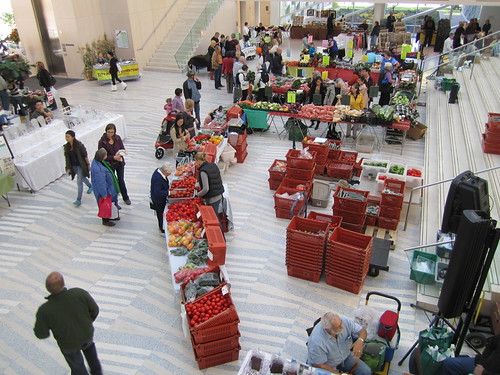
Inside City Hall
Kuhlmann’s, Doef’s (and now Erdmann’s) are the only consistent vegetable vendors present, and if they happen to sell out of a particular item, you are out of luck. It is a bit better on the protein side, with a number of vendors offering meats (Serben Free Range sells pork and turkey, while both Nature’s Green Acres and Sunshine Organic have beef, for example). Still, Mack and I find ourselves visiting the Old Strathcona Farmers’ Market once in a while, to stock up on products unavailable at the City Market.
I recognize that for vendors, it may not be lucrative to participate in markets that don’t have a large customer base. Case in point, both Irvings and Gold Forest Grains pulled out of the indoor market this year because of declining sales. On the flip side (the chicken-egg argument), it is challenging for a market to attract shoppers without a solid variety of products.
So why do I care? Why should you care? It’s a functioning market, why shouldn’t it continue on as is? While I don’t necessarily think we need to replicate the Old Strathcona Farmers’ Market for those of us north of the river, I also don’t think that City Hall is the long-term solution. After rejecting the Mercer Warehouse as a potential year-round location, the Board was tasked with continuing the search. They have since signed a three year agreement to operate out of City Hall until the winter of 2015, and I worry that this has made them a bit complacent, with the lure of an inexpensive space trumping the desire to fulfill a vision of what could be. A mix of stalls for vending and concessions. Open spaces for buskers. Multiple seating areas. A children’s play space. The option to open for more than one day.
I want the year-round City Market to better reflect its outdoor self, and for that to happen, I think they need to seriously consider alternative spaces.








 Only Here for the Food